. 鬼子母神と伝説 Legends about Kishibojin .
:::::::::::::::::::::::::::::::::::::::::::::::::::::::::::::::::::::::::::::::::::::::::::::::::::::
Daruma Pilgrims Gallery
:::::::::::::::::::::::::::::::::::::::::::::::::::::::::::::::::::::::::::::::::::::::::::::::::::::
Mii Temple 三井寺 Miidera, Mii-dera
園城寺 Onjo-ji Temple
This is Temple Nr. 14 on the Saigoku Pilgrimage to 33 Temples of Kannon Bosatsu.
(Not to mix it up with Kimii-Dera, Nr. 2.)
The brother of Murasaki Shikibu was an abbot of this temple and her father took the vows there.
The deity Kishibojin is also venerated here.

Mii-dera Temple (Onjo-ji Temple)
Mii-dera is the temple that exercises control over the Tendai-jimon sect of Buddhism. Originally it was the main inner temple of the Tendai-jimon sect. Separating from the other temples on the mountain Hiei-zan in 13th century, it became an independent temple.
 Cherry Blossom Season 三井寺の桜
The front of the temple gate, which is made of a stone wall, conveys the history of the contention between Mii-dera and Enryaku-ji (the latter being the temple that exercised control over the Tendai sect).

Golden Hall 三井寺金堂
The Golden Hall, Kon-do, designated as a National Treasure, is a hall that enshrines an image of Miroku-Bosatsu, a Bodhisattva who is supposed to appear in the future world as the successor of the Buddha. Other structures here have been designated as Important Cultural Properties, including the Nio-mon (a gate with images of Deva kings on either side), on both sides of the entrance to which stand Buddhist images, and the three-storied pagoda.
The sound of the bell at this temple has been admired for its beauty in literature since ancient times. With 1,500 cherry trees in the grounds, this temple is also famous for its cherry blossoms.
© Japan National Tourist Organization
:::::::::::::::::::::::::::::::::::::::::::::::::::::::::::::::::::::::::::::::::::::::::::::::::::
This famous temple has been the subject to many woodblock prints too.
Here is one by Hiroshige. Click on the thumbnail to see more.

Mii no Banshô, Evening bell at Mii Temple
三井の晩鐘
Japanese Pilgrimages Sacred to the KANNON BODHISATTVA (Avalokitesvara)
:::::::::::::::::::::::::::::::::::::::::::::::::::::::::::::::::::::::::::::::::::::::::::::::::::::

Priest Raigo of Mii Temple
Transformed by Wicked Thoughts into a Rat
Yoshitoshi, Taiso, 1839-1892
Raigō (1004-1084) was an actually historical figure around whom has been spun a fascinating tale. A Buddhist monk of the Tendai sect he was attached to the temple of Mii-dera at Lake Biwa. "Various chronicles relate that by virtue of Raigō's prayers a son was born to the retired emperor Shirakawa (1053-1129), in return for which Shirakawa offered to grant the priest any wish. When Raigō requested the establishment of an ordination platform at Onjō-ji [an alternate name for the temple at Mii-dera], however, the retired emperor reneged on his promise, for fear of the armed monks of the rival Tendai temple Enryaku-ji on Mt. Hiei, who enjoyed a monopoly on ordination. Casting a curse on Shirakawa, Raigō shut himself in the Buddha Hall of the temple and began a fast in protest."
John Stevenson continues the story: "Shirakawa sent conciliatory messages, but Raigo was implacable and eventually starved himself to death. Prince Atsuhisa [the son born to Shirakawa] died soon afterwards. Raigo's vengeful spirit changed into a thousand rats which infested the temple, destroying the Emperor's sacred books and scrolls and doing untold damage."
© Prints of Japan
:::::::::::::::::::::::::::::::::::::::::::::::::::::::::::::::::::::::::::::::::::::::::::::::::::
Masks and Costume for the Noh Play "Miidera"
Exhibition Tokyo National Museum
September 2008
Miidera temple, also known as Onjoji, is located in Omi province (Shiga prefecture) by Lake Biwa, and was famous for the sound of its bell. In the Edo period (1603-1868) the "Evening Bell from the Temple of Mii" was counted as one of the "Eight Views of Omi".
The Noh play "Miidera" revolves around a woman whose son was kidnapped by a slave dealer. She was finally able to meet the child again with the help of the bell of Miidera.
The woman, who lost sanity after her son was kidnapped, is staying at Kiyomizudera temple in Kyoto. The actor in her role wears a karaori with an autumn grass design in subdued colors without hakama (traditional Japanese trousers), and uses a mask of a middle-aged woman such as shakumi or fukai. One day, the insane woman has a dream in which she is told that if she goes to Miidera, she will be able to meet her child. Delighted, she prepares and sets out for a trip to the temple. When she arrives at Miidera, it is jugo-ya (full-moon night), and temple priests, wearing sunboshi caps and mizugoromo coat over noshime garments, are enjoying the full moon with a boy attendant. The sound of the temple bell, struck by the sexton wearing a kataginu vest and hanbakama trousers, can be heard.
Being expected to perform an interesting trick, the woman who lost her child is invited to the moon-viewing party. The insane mother, now in a mizugoromo coat and koshimaki (a garment worn in wrap-around-the-waist fashion), is elated by the beautiful moonlight and begs for permission to strike the bell. Finally the permission is granted and she begins to strike the bell. The boy attendant, who was enjoying the full moon, realizes the woman is his mother. When the boy asks the insane woman about her hometown, she recognizes his voice as her son's. Overjoyed, the mother and son leave for home.
The drama, featuring animated scenes of bell striking alternated with elegant moon-viewing scenes, is a popular work and is still often performed in autumn today.
source : www.tnm.go.jp
:::::::::::::::::::::::::::::::::::::::::::::::::::::::::::::::::::::::::::::::::::::::::::::::::::::

Chisho, named Enchin during his lifetime, was one of the founders of the Tendai Buddhist sect. He was born in 814 in Sanuki province (modern Kagawa prefecture). His mother was the niece of Kukai.
Chisho decided during his 22 year long religious training at Mount Hiei (Kagoyama Shugyo), to devote his life to Fudo Myoo (the “Unmovable King of Wisdom”, Buddhist deity). Still today, an image of Fudo Myoo (national treasure, normally withheld from the public) is enshrined in the Mii-dera temple.
He became the first head of the current temple in 859, and 10 years later the fifth head of the Tendai sect, and so during 24 years, devoting his life to the development of Buddhism in Japan. He passed away on October 29, 891 at the age of 78 years old.
Emperor Daigo gave him his posthumous name of “Chisho”.
- source : shiga-miidera.or.jp -
. 智證大師 Chisho Daishi - Enchin 圓珍 - 円珍 .
(814 - 891)
. Fudo Myo-O Gallery 不動明王 .
:::::::::::::::::::::::::::::::::::::::::::::::::::::::::::::::::::::::::::::::::::::::::::::::::::::
The origin of the ringing the bell at Temple Miidera
Once there was hebi nyoobo ヘビ女房 a serpent wife that was blind.
She wanted a reminder when it became light in the morning and asked for the bell to be rung.
Therfore they begun to ring the bell six times in the morning
:::::::::::::::::::::::::::::::::::::::::::::::::::::::::::::::::::::::::::::::::::::::::::::::::::::
Found in my archives :
Let us look at the Japanese word for monk or priest, boozu 坊主.
This is originally the word for the head priest of a temple or retreat (ichiboo 一坊、一寺) and only later was used for any monk. Some priests and monks were called Tera Hooshi (tera booshi) or Yama Hooshi at Temple Enryaku-Ji (寺法師、山法師), but in contrast to them, the priests and monks from Temple Mii-Dera were called boozu or Honorable Priest, goboo 御坊.
Later during the Edo period, young priests who worked for a local lord (daimyoo) or the Edo government were also called boozu. Nowadays, any young boy with a shaven head is a boozu.
(Quoted from Saijiki for Buddhist Events )
 © PHOTO Shigero Otsu-E
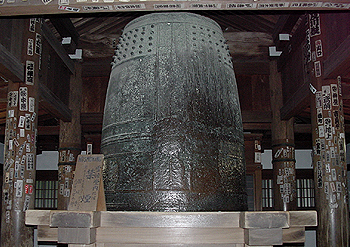
 During the wars between the temples of Mt. Hiei and Miidera, the famous soldier-priest Benkei took the huge bronze bell from the temple and carried it up to Mt. Hiei.
Photo of the temple bell
This story is famous in the paintings of Otsu, like the one on the left.
More in my article about the
Pictures from Otsu 大津絵
More about temple bells and haiku
More about the strong Benkei and haiku
A Deity venerated at Miidera
Matarajin, Madarajin, Matara-Shin 摩多羅神
:::::::::::::::::::::::::::::::::::::::::::::::::::::::::::::::::::::::::::::::::::::::::::::::::::::
三井寺名物「弁慶の力餅」
Benkei no Chikaramochi
三井寺力餅 Chikara-mochi from Mii-dera

. Mochi もち (餅) ricecakes, rice cake of all kinds
These CHIKARAMOCHI are also sold at other temples with a relation to Benkei, the strong warrior-monk. For example in Iwate, near the temple Chuson-ji.
. Musashibo Benkei 弁慶 and Hiraizumi
. Daisanji . 大山寺 and Chikaramochi
Yashima, Shikoku
:::::::::::::::::::::::::::::::::::::::::::::::::::::::::::::::::::::::::::::::::::::::::::::::::::
.................. H A I K U
Visiting Buddhist Temples with
. Matsuo Basho 松尾芭蕉 - Archives of the WKD .
三井寺の門たたかばや今日の月
Mii-dera no mon tatakaba ya kyoo no tsuki

The Gate 三井寺仁王門
I want to knock
on the gate of Mii Temple ...
the moon of tonight
Matsuo Basho
Tr. Gabi Greve
mon o tataku can literally mean to knock. It is also used for a student or newcomer who wants go get permission to study with a master at a temple or in a school or home.
kyoo no tsuki, a mid-autum kigo referring to the full moon of autumn.

Memorial Stone of this haiku
© PHOTO Y. Morimoto
Mii Temple,
I'd love to knock on its gate:
tonight's moon
Tr. David Barnhill
Mii Temple
knocking on the gate for a wish
today's moon
Tr. Jane Reichhold
shall we go and knock
on the gate of Mii Temple?
the moon of tonight
Tr. Makoto Ueda
Combining information from Barnhill and Ueda, this hokku was written in 1691, on the 15th of Eight Month (September 7). It was written at an evening moon-viewing party which Basho hosted at his hut at Gichuu Temple 義仲寺, a few miles from Mii Temple on the southern shore of Lake Biwa.
The hut (cottage) was called the Mumyoo ("nameless 無名") Hut.
According to Ueda, "Basho loved the cottage, so much so that he was later to will that his body be buried there when he died."
The hokku draws on lines by Chia Tao (Jia Dao) (779-843)
Birds sleep in trees by the pond.
Under the moon, a monk knocks on the gate.
(trans. Barnhill)
One Japanese commentator (Nobutane) imagines walking "along the beach from Gichuu Temple to Mii Temple and look[ing] over the lake from the hill where the latter temple is located. From there, one can see all of the eight famous views of Lake Biwa."
And another commentator (Shida) imagines Basho enjoying the moon from a boat on Lake Biwa. "From the lake, he could tell whereabouts Mii Temple was located. The boating under the moon was so enjoyable that he did not want to go straight home. He wondered if monks at Mii Temple too were not viewing the moon and reciting poetry, and he felt like stopping by the temple and chatting with them over a cup of tea."
And yet another commentator (Iwata) says that this hokku's "profundity is further increased by its peripheral allusion to the noo plays 'Miidera' (Mii Temple) and 'Tooru'."
(commentator translations by Ueda)
Compiled by Larry Bole - Translating Haiku Forum
Matsuo Basho and
. - Gichuuji 義仲寺 Gichu-Ji - Mumyooan 無名庵 - .
- - - - -
七景は霧にかくれて三井の鐘
shichi kei wa kiri-ni kakurete Mii-no-kane
Eight views?--Ah, well,
mist hid seven when I heard
Mii-dera's bell.
Tr. Henderson
The Discussion is HERE
The Four Directions in Haiku
Visiting Buddhist Temples with
. Matsuo Basho 松尾芭蕉 - Archives of the WKD .
:::::::::::::::::::::::::::::::::::::::::::::::::::::::::::::::::::::::::::::::::::::::::::::::::::::
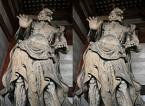
Nio-O Statues from Temple Horyu-Ji
からびたる三井の仁王や冬木立
karabitaru Mii no Nioo ya fuyu kodachi
The two Deva Kings
Stand weather worn,
Among the wintry groves of Mii Temple.
からびた(乾ききった)仁王像と冬木立がよく響くのである。
Kikaku 其角
Tr. R.H. Blyth
all dried out
the Deva Kings' statues at Mii temple -
trees in winter
Tr. Gabi Greve
Details about
Deva Kings at the Temple Entrance... and haiku
:::::::::::::::::::::::::::::::::::::::::::::::::::::::::::::::::::::::::::::::::::::::::::::::::::::
hi kuretari ..... descending with day
mi’i dera kudaru ..... from Mii Temple,
haru no hito ..... the people of spring
Katō Gyōdai (1732-92)
Tr. Michael Haldane
:::::::::::::::::::::::::::::::::::::::::::::::::::::::::::::::::::::::::::::::::::::::::::::::::::::
kigo for early summer
sendango 千団子 (せんだんご ) "1000 dumplings"
sendango matsuri 千団子祭(せんだんごまつり)
festival of the one thousand dumplings
sendango moode 千団子詣(せんだんごもうで)visiting the temple Miidera
sendankoo 栴檀講(せんだんこう)group for the chinaberry
sendankoo 千団講(せんだんこう)group for the 1000 dango
Kijibojin mairi 鬼子母神参(きじぼじんまいり)
pilgrimage to visit Kishibojin
Kishibojin matsuri 鬼子母神祭 Kishibojin Festival
(sometimes listed for the New Year or Autumn)
There is a well in the precinct of this temple which is said to have been used for hot water immersion ceremonies (ubuyu) at the birth of three emperors who lived during the 8th century. The Sendango Matsuri Festival is an ancient ceremony in which people pray in the hope that their children will grow up safely.
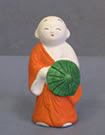 Kishibojin used to eat children before she was converted by Shakyamuni Buddha. Now she is the protector of children. The 1000 dumplings mark the 1000 children she has eaten and is now praying for their deliverance in the afterlife.
Little clay dolls すくすく人形 of all kinds are sold during the festival.
On the festival day, stalls with trees and saplings are offering their plants and small turtles are sold to be released in the pond.
. . . CLICK here for Photos !

ははそばの紅葉がくれの鬼子母神
hahasoba no momiji gakure no Kishibojin
hidden in the red leaves
of the Emperor Oak trees -
Kishibojin
Etsugu Mamoru えつぐまもる
hahaso 柞 = Quercus dentata, Japanese Emperor Oak
. Hahaso Momiji 柞紅葉 kigo .
. WASHOKU
Dango KIGO during all seasons
Mark Schumacher has all the details about
Kariteimo 訶梨帝母, Karitei, Kishibojin, Kishimojin, Kangimo
Hariti = Sanskrit
A deity eating children, later pomegranates (zakuro ザクロ) instead, after Shakyamuni Buddha convinced her not to eat children any more.
. Pomegranates as KIGO

Ema votive tablet from the temple in Tokyo
zakuro ema 鬼子母神のざくろ votive tablet with pommegranate
. susuki mimizuku すすきみみずく
horned owls made from susuki grass .
Kishibojin Temple in Ikebukuro, Tokyo

Photo from my friend Nakamura Daruma san.
mimizuku tumbler doll 起き上がり
. Amulets and Talismans from Japan .
fukuroo 梟 - ふくろ - 福ろ Fukuro, auspicious owl
:::::::::::::::::::::::::::::::::::::::::::::::::::::::::::::::::::::::::::::::::::::::::::::::::::::
kigo for early winter
Kisshoo-in hakkoo 吉祥院八講 きっしょういんはっこう
ceremony at temple Kisho-In
Kisshoo-in hokke e 吉祥院法華会(きっしょういんほっけえ)
ceremony for the Lotus Sutra
There are various Kissho-In temples in Japan.
The most important one is the 吉祥院 - 京都市南区 in Kyoto, Minami ward.
During the ceremony session in the morning and the evening for 4 days a chapter of the sutra was read and rituals for the souls of departed held.
There was also classical music and poetry readings 詩歌,連歌.
This ceremony is not practised in our days.
A ceremony of the Hokke Hakkoo 法華八講
"Eight recitations of the Lotus Sutra scrolls"
at the shrine Shirohige Jinja 白髭神社 with prayers to the deity Hira Myoojin 比良明神 (Hira gongen 比良権現, Shirohige Myojin 白鬚明神).
. Hokke Hakkoo 法華八講 ceremonies for the lotus sutra .
:::::::::::::::::::::::::::::::::::::::::::::::::::::::::::::::::::::::::::::::::::::::::::::::::::::
A whole family of bugs which leave a terrible smell when touched or when they feel in danger. In autumn they try to come inside the old farmhouses.
. Fart-bug, he-kiri mushi, he-hiri mushi 屁ひり虫
Miidera gomimushi 三井寺ごみむし(みいでらごみむし)
Miidera hanmyoo 三井寺斑猫(みいでらはんみょう)
:::::::::::::::::::::::::::::::::::::::::::::::::::::::::::::::::::::::::::::::::::::::::::::::::::
External LINKs
http://www.taleofgenji.org/onjoji.html
http://www.pref.shiga.jp/minwa/03/03-04.html
:::::::::::::::::::::::::::::::::::::::::::::::::::::::::::::::::::::::::::::::::::::::::::::::::::::
:::::::::::::::::::::::::::::::::::::::::::::::::::::::::::::::::::::::::::::::::::::::::::::::::::::
Kariteimoten (Hariti)
Kishimojin
Mutter von Kichijooten.
Kishimojin = Göttliche Dämonenmutter.
Kankibo = Frohe Mutter.
Aishibo = Kinderliebende Mutter.
In Japan gab es eine eigene kinderschützende Gottheit (koyasu no kami), die auch eine leichte Geburt gewährte. Ihr Name ist Konohana no sakuya hime no mikoto und sie ist sie Göttin des Berges Fujisan.
Möglicherweise eine Personifizierung einer tropischen Kinderkrankheit.
War zunächst eine Dämonin, die selbst 1000 Kinder besaß und doch die Kinder anderer Mütter auffraß. Durch die Lehre des Shakyamuni wurde sie bekehrt. Im Sutra Konkoo Myookyookyoo als Schutzgöttin des Buddhismus, besonders aber der kleinen Kinder, erwähnt. Ihr Gefolge sind die 10 Dämonenfrauen (Juurasetsunyo). Manchmal als Steinfiguren, mit Kariteimo etwas größer als die 10 Dämonen~frauen.
Auch in der Inkarnation einer kinderschützenden Kannon (Koyasu Kannon) oder eines kinderschützenden Jizoo (Koyasu Jizoo) bekannt.
In der Nichiren-Sekte besonders als Schutzgöttin für leichte Geburt und Kindererziehung verehrt.
Ikonografie:
Zuerste sitzende, später fast nur stehende Figuren.
Manchmal als männliche Dämonen-Gottheit, mit verstrubbelten Haaren dargestellt, aber häufiger als weibliche Figur, mit einem Säugling an der Brust und mehreren Kleinkindern auf dem Arm. Auf Bildern erscheint sie auch von fünf Kindern umgeben.
Das rechte Bein hängt oft herab, das linke liegt quer. Selten sitzend mit untergeschlagenen Beinen.
Herabhängende Haare, mit einer Krone. Manchmal opfern an ihrer Statue die Frauen auch ihre eigenen Haare.
In der Hand einen rotfleischigen, vielkernigen Granatapfel, ein Fruchtbarkeitssymbol. (Als Shakyamuni die Kariteimo-Dämonin bekehrte, gab er ihr einen Granatapfel und sagte: "Wenn Du das nächste Mal Lust auf Kinderfleisch bekommst, dann iß diesen ähnlichschmeckenden Apfel anstatt eines Kindes und gib Dich damit zufrieden.")
. Buddhastatuen ... Who is Who
Ten 天 (Devas)
. Koyasu no kami 子安の神 Protectors of Children .
. 鬼子母神と伝説 Legends about Kishibojin .
:::::::::::::::::::::::::::::::::::::::::::::::::::::::::::::::::::::::::::::::::::::::::::::::::::::
[ . BACK to WORLDKIGO TOP . ]
[ . BACK to DARUMA MUSEUM TOP . ]
:::::::::::::::::::::::::::::::::::::::::::::::::::::::::::::::::::::::::::::::::::::::::::::::::::::


 Posts
Posts


13 comments:
Ram Krishna Singh :
It's simply GREAT, Gabi san
Doris Kasson :
Thanks again Gabi for sharing wtih us....
Masaoka Shiki visiting
三井寺に颯と湖水の時雨哉
三井寺の釣鐘うなる野分哉
三井寺の釣鐘なびく野分哉
三井寺の鐘さびついて呼子鳥
三井寺は三千坊の若葉哉
三井寺や三千坊の魂祭
三井寺や湖濛々と五月雨
三井寺をのぼるともしや夕桜
kenponchakushoku Fudoo Myoo-Ooo 絹本著色不動明王像
silk-based colored painting of Fudo Myo-O
Yellow Fudo from Mii-dera
and
Konjiki Golden Fudo 金色不動明王
- Mochi 餅 rice cakes and 妖怪 Yokai monsters -
.
http://kappapedia.blogspot.jp/2015/05/mochi-and-yokai.html
.
立正院 きしもじん Rissho-In Kishimojin
福島市松川町信夫隠5番地 Fukushima
With an ema votive tablet for Rokusan 六三 to avoid illness.
.
http://heianperiodjapan.blogspot.jp/2016/01/rokusan-six-three.html
.
Onipedia -
Kishibojin - 13 legends to explore
.
https://kappapedia.blogspot.jp/2017/02/onipedia-demons-of-japan.html
.
Kishibojin, Kishimojin 鬼子母神と伝説 Legends about the deity Kishibojin
訶梨帝母 Kariteimo - Kangimo 歓喜母 - the Mother of Child-Eating Demons
.
https://heianperiodjapan.blogspot.jp/2017/04/kishibojin-kishimojin.html
.
鬼 the Kanji character for ONI usually has a horn on the head.
The writing for Kishibojin is often seen without the horn on the Kanji, since she turned a protector deity.
.
Board at
雑司ヶ谷鬼子母神 Tokyo, Zoshigaya Kishibojin Temple
.
https://kappapedia.blogspot.jp/2017/04/oni-tsuno-horns.html
.
kishiojin キシオジン Kishibojin
In the dialect of Okayama
And Legends about her
.
13 legends to explore
.
https://kappapedia.blogspot.jp/2017/05/mado-monster-road.html
.
Kyootai Osho 教待和尚 Kyotai Osho, Priest Kyotai
He is Nr. 14 of
. 日本の仙人37人 - The 37 Immortals of Japan .
教待堂 Kyotai Do Hall
at temple Miidera, Shiga, Otsu.
He was an old priest taking care of Miidera until priest 智証大師 Chisho Daishi came to the temple.
In the Kyotaido Hall in honor of Kyotai there is a statue of the priest.
.
https://heianperiodjapan.blogspot.com/2018/04/sennin-kyotai-osho.html
.
レレレの千手観音 - 三井寺
By 赤塚不二夫 Akatsuka Fujio
.
https://gokurakuparadies.blogspot.com/2019/04/manga-and-buddha.html
.
. Mii Temple 三井寺 Miidera, Mii-dera .
- quote -
The temple bell, Benkei no hikitsuirgane, which was manufactured during the Nara period, is said to have been donated to the Mii-dera temple as an expression of gratitude to Fujiwara no Hidesato for the Extermination of the Centipede (“Mukade Taiji”, a legendary episode) living on mount Mikamiyama.
The bell is also said to have been brought back from Ryu-gu, the underwater Palace of the Dragon King.
In the tenth century, during the succession disputes which broke out between Tendai monks, Benkei (a warrior monk, popular subject of Japanese folklore) took the bell away and dragged it up to the summit of mount Hiei. There, he tried to strike it and got mad when he heard it ringing “eeno eeno”, which means “I want to go back” in the Kansai dialect.
Benkei then threw the bell down to the bottom of the valley.
The scars and cracks which can be seen on the bell are said to be traces of this episode.
- source : shiga-miidera.or.jp ... -
,
in my blog
https://gokurakuparadies.blogspot.com/2021/04/chinsho-sunken-bell-legends.html
.
Post a Comment