Showing posts with label Dragon. Show all posts

2/24/2008

Dragon King Sutra

[ . BACK to DARUMA MUSEUM TOP . ]

:::::::::::::::::::::::::::::::::::::::::::::::::::::::::::::::::::::::::::::::::::::::::::::::::::::

Dragon Art Gallery

:::::::::::::::::::::::::::::::::::::::::::::::::::::::::::::::::::::::::::::::::::::::::::::::::::::

Dragon King Sutra

The dragon people, or Nagas, appear in many stories throughout the Buddhist canon. The Buddha preached a very brief sutra to them, in which he says that theirs is a rebirth of extraordinary beauty. The Naga princess, who has no name but whose story is famously told in the Lotus Sutra, demonstrates the ease with which a wise being can transform from shape to shape. Her story has been interpreted in more than one way over the years.

Another woman of the Naga realms appears in the Sutra of Sagara, the Naga King, also called the Ocean Dragon King Sutra. (The sutras are deeply interrelated, and so are their characters. King Sagara is the father of the nameless princess.) Another dragon woman, known by the name Silk Brocade and other titles, meets the Buddha in this sutra when he travels to the dragon's kingdom beneath the sea.

 © Sallie Tisdale
Women of the Way


:::::::::::::::::::::::::::::::::::::::::::::::::::::::::::::::::::::::::::::::::::::::::::::::::::::


Dragon King Mantra


Averting All Hindrances Mantra
Translated from Chinese by Dr. Yutang Lin


Fearless, fear-free .. Pacify all fears ..
Give fearlessness .. Transcend through awakening


Nothing to disturb .. Pacify all disturbances ..
Nothing to argue .. Refrain from disputing ..
No anger hovered .. Nothing to die for


Pure awe-inspiring .. Awe-inspiring tracks ..
Great awe-inspiring .. Eternal tranquillity

Approach compassion .. Remove flaws ..
Reveal truths .. Neither fall short nor over

The common meaning .. The auspicious meaning ..
Nectar statements .. Seeing the essentials


To guide and control .. With open mind ..
The sequence of activities .. Never reach end

Brightness un-born .. Born of purity ..
Fresh, clean and light-shinning statements

Equality in accordance with equal mind ..
Reach the unsurpassable

Silas set up by Buddha are pure ..
No transgression .. No disobeying

Conquer devil's arena .. Victorious over other paths .
Shinning the clarity of Dharma

Convert through giving teachings ..
Open up Dharma treasures


Comment:

This awe-inspiring mantra was bestowed by Sakyamuni Buddha as recorded in Section 20 of the Buddha Expounding on the Ocean Dragon King Sutra (Fo Shuo Hai Long Wang Jing).
The original mantra is continuous without breaking into sections. In order to facilitate understanding and memorization, I have rendered the text into 10 consecutive lines.
© Yutang Lin, August 1, 2003

:::::::::::::::::::::::::::::::::::::::::::::::::::::::::::::::::::::::::::::::::::::::::::::::::::::


Read a GOOGLE BOOK
The Way to Buddhahood:
Instructions from a Modern Chinese Master
Yin Shun


CLICK for more information


:::::::::::::::::::::::::::::::::::::::::::::::::::::::::::::::::::::::::::::::::::::::::::::::::::::


Ocean Dragon King Sutra: Ratnavati

Ratnavati is named as a mythical ancestor, because her story is told only in a sutra. In the Ocean Dragon King Sutra, she is described as a girl living at the time of Shakyamuni. She argued with Makakashyo, Shakyamuni's first Dharma heir and our second ancestor.

Makakashyo told Ratnavati, "You cannot attain enlightenment, because you are female. Women cannot attain full enlightenment."

Ratnavati answered, "If one has a pure mind and body, if one's heart is firmly set on enlightenment, then full Buddhahood is already in your grasp. There is no real difference between men and women. If women cannot attain full enlightenment, then neither can men. Enlightenment has nothing to do with this thing of being male or being female."

It is said that Makakashyo answered, "If you put it like that, you must be right."

Shakyamuni Buddha then predicted Ratnavati's full enlightenment, without stipulating that she would first have to become a man.
http://www.dharma-rain.org/StillPoint/archives/SPjan_feb00.shtml


Dragon King ! CLICK for more photos
Dragon King


:::::::::::::::::::::::::::::::::::::::::::::::::::::::::::::::::::::::::::::::::::::::::::::::::::::


spring surprize -
the Dragon King shows me
his secrets


.Ryuu-oo 竜王 Ryu-O - The Dragon King .

Dragon Art Gallery

:::::::::::::::::::::::::::::::::::::::::::::::::::::::::::::::::::::::::::::::::::::::::::::::::::::

2/08/2008

The Dragon's Gift

[ . BACK to DARUMA MUSEUM TOP . ]

:::::::::::::::::::::::::::::::::::::::::::::::::::::::::::::::::::::::::::::::::::::::::::::::::::::

DRAGON Gallery

:::::::::::::::::::::::::::::::::::::::::::::::::::::::::::::::::::::::::::::::::::::::::::::::::::::

The Dragon's Gift:

The Sacred Arts of Bhutan

February 26 - May 23, 2008


This catalogue accompanies The Dragon's Gift: The Sacred Arts of Bhutan, one of the most highly anticipated exhibitions of Buddhist art to be held in recent times. For over five years, the Honolulu Academy of Arts, under the direction of Dr. Stephen Little, has conducted ambitious fieldwork and research in Bhutan. Enjoying a close working relationship with the Royal Government of Bhutan, the Honolulu Academy of Arts research teams have been given unprecedented access to the nation’s treasuries of sacred art and dance.

The Dragon's Gift offers a rare opportunity to introduce, to the wider international audience, some of the most sacred Buddhist images of Bhutan. From the wealth of material surveyed, the organizers of the exhibition have selected over one hundred objects of superior aesthetic achievement and deep religious significance, the vast majority of which have never before been seen in the West. Nearly all of the works of art presented in this catalogue are from active temples and monasteries and remain in ritual use.

Most of the items are painted or textile thangkas or gilt bronze sculptures which date primarily from the 17th to the 19th centuries – a golden age in the Buddhist arts of Bhutan. Ranging from depictions of Tantric deities to individualized portraits of Buddhist masters, the exhibition and catalogue present outstanding works of art with a wide iconographic scope. For the Buddhist people of Bhutan, these sacred items are conceived as supports along the journey to enlightenment, and are of vital spiritual significance.
© www.serindia.com

:::::::::::::::::::::::::::::::::::::::::::::::::::::::::::::::::::::::::::::::::::::::::::::::::::::


Buddha Vajrasattva
16th century
Dongkarla Kunzang Choling, Paro


Bodhisattva Manjushri, 18th century
Ink and mineral colors on cotton
Height: 201 x Width: 100 cm
Trashigang Gönpa, Thimphu


The Dragon’s Gift introduces such key Buddhist masters in Bhutan’s history as Padmasambhava (also known as Guru Rinpoche, 8th century, who first brought Tantric Buddhism to Bhutan), Pema Lingpa (1450–1521, a famous “Treasure Revealer”), Drukpa Kunley (1455–1529, the “Divine Madman”), and Zhabdrung Ngawang Namgyel (1594–1651, the unifier of Bhutan), and such key religious figures as Buddhas, bodhisattvas (including the powerful female deities Tara and Prajnaparamita), and wrathful deities (including Mahakala and Yamantaka).

The exhibition’s timing is significant as it opens in 2008, during which Bhutan will transform itself into a democratically elected constitutional monarchy.

© www.curatedobject.us

:::::::::::::::::::::::::::::::::::::::::::::::::::::::::::::::::::::::::::::::::::::::::::::::::::::


Bhutan is the only country in the world to adopt Vajrayana, or Tantric Buddhism, as its official religion, and the particular form of Buddhism found in Bhutan permeates all aspects of culture and the arts. Bhutan is remarkable for the antiquity and continuity of its Buddhist teachings, with the first temples in the region established during the seventh century. The arts of the two main branches of Vajrayana Buddhism in Bhutan, the Drukpa Kagyu and the Nyingma schools, will be represented in the exhibition.

CLICK for more photos
Dzong Fortresses


The exhibition is divided into 12 sections.

Section One: Buddhas
Shakyamuni, the historical founder of Buddhism in the fifth century B.C., is the first image encountered in the exhibition. Paintings depicting his life and previous incarnations complement sculptural representations. Depictions of the five cosmic Buddha Families, such as an elaborate sculpture of Aksobhya, provide a broader definition of Buddhahood.


Section Two: Bodhisattvas
Bodhisattvas, beings who defer their own attainment of complete Buddhahood to assist others on the path to enlightenment, are highly venerated in the Vajrayana Buddhist tradition. This section introduces such popular and revered Bodhisattvas as Manjushri, shown in multiple forms including a sumptuous painted thangka of the White Manjushri, Vajrapani, and Avalokitesvara.


CLICK for more illustrations
Padmasambhava


Section Six: Deity Yoga
A wide variety of spiritual figures comprise the Buddhist pantheon in Bhutan. Many of these deities are the focus of Buddhist ritual practices such as visualizations and mantra chanting. This section introduces these figures, the concepts they represent, and associated practices. Examples include a powerful yab-yum sculpture of Vajrasattva and his consort, representing the feminine wisdom and masculine “skillful means” (upaya) that lead from ignorance to enlightenment.


Section Eight: Mandala
Perhaps no visual expression of Buddhist thought is as mysterious and attractive to the Western viewer as the mandala. Intricate spiritual diagrams that are considered maps leading to wisdom and spiritual knowledge, mandalas are powerful tools employed in the quest for enlightenment. A variety of painted mandalas will be presented along with references to associated ritual practices.

© www. Honolulu Academy of Arts


:::::::::::::::::::::::::::::::::::::::::::::::::::::::::::::::::::::::::::::::::::::::::::::::::::::


Read more in ORIENTATIONS

CLICK to go to Orientations

The geographical inaccessability of Bhutan has for centuries shrouded the Himalayan kingdom in mystery and romance. However, as this tiny nation begins to open itself to the world, a dynamic society which honours traditions and preserves values is revealed. In 2003, Stephen Little, Director of the Honolulu Academy of Arts, began negotiations with the Royal Government of Bhutan to organize an international exhibition to highlight its unique culture. Five years in the planning, `The Dragon's Gift: The Sacred Arts of Bhutan' opens in Honolulu on 24 February, accompanied by a symposium.

In this issue, essays by Terese Bartholomew, John Johnston and Dorji Yangki highlight distinctive aspects of Bhutan's art and architecture.

Joseph Houseal, Mark Fenn and Ephraim Jose demonstrate how this project extended beyond the selection of artefacts for display. The creation of an archive documenting ritual dance traditions and the setting-up of workshops to educate people in the practices of restoration and conservation reflect the unprecedented engagement of a foreign cultural institution with different levels of Bhutanese society.

© Volume 39 - Number 1 - January/February 2008


:::::::::::::::::::::::::::::::::::::::::::::::::::::::::::::::::::::::::::::::::::::::::::::::::::::

Reference :

The Gong Due Ritual Dance Visualization
Sand Mandala

CLICK for enlargement
Core of Culture Dance Preservation, Bhutan
Expedition Leader: Joseph Houseal 2004-2006


:::::::::::::::::::::::::::::::::::::::::::::::::::::::::::::::::::::::::::::::::::::::::::::::::::::

CLICK for more photos !
Black Hat Dance, Zhanag and Cham Dance


Five Bhutanese Offerings of Sensory Enjoyment

silk cloth for the touching fingers
conch shell with yoghurt for the nose
mirror for the eyes
cymbals for the ears
sweet fruit for the tounge


The Encyclopedia of Tibetan Symbols and Motifs


the Dragon's gift -
an online traveller
folds his hands


... ... ... ... ... . BHUTAN SAIJIKI


Dragon Art Gallery

:::::::::::::::::::::::::::::::::::::::::::::::::::::::::::::::::::::::::::::::::::::::::::::::::::::

7/17/2007

Dragon Calligraphy

[ . BACK to DARUMA MUSEUM TOP . ]

:::::::::::::::::::::::::::::::::::::::::::::::::::::::::::::::::::::::::::::::::::::::::::::::::::::

Dragon Art Gallery

:::::::::::::::::::::::::::::::::::::::::::::::::::::::::::::::::::::::::::::::::::::::::::::::::::::

Dragon as Calligraphy

:::::::::::::::::::::::::::::::::::::::::::::::::::::::::::::::::::::::::::::::::::::::::::::::::::


TRACES OF NO-MIND: JAPANESE ZEN CALLIGRAPHY
Exhibition 2001

This exhibition focuses on the highly charged and often powerfully gestural works of many of the great names of the Zen calligraphic tradition. It provides a rare opportunity to see a genre of work that, despite its centrality to the Japanese artistic canon, has had little exposure in Britain.


Dragon
Tesshu Yamaoka (1836-1888), 1880
height 135 cm


© www.vam.ac.uk/vastatic
Victoria and Albert Museum, London


山岡 鉄舟(やまおか てっしゅう Yamaoka Tesshuu )


Yamaoka Tesshu was an outstanding swordsman of the nineteenth century who attained spiritual enlightenment at the age of 45. As well as a master swordsman, he was a renowned calligrapher- another testament to his mastery of Zen. He was born in Edo (modern day Tokyo) as Ono Tetsutaro on June 10th, 1836. His father was a retainer of the Tokugawa Government and his mother was the daughter of a Shinto priest from Kashima Shrine. Tesshu practiced Kendo from the age of nine, starting in the Jikishinkage Ryu Tradition.

Later his family were to move to Takayama where he began the Ono Ha Itto-Ryu style of fencing. When he was seventeen, he returned to Edo and joined the Kobukan Military Institute and the Yamaoka School of Spear Fighting under Yamaoka Seizan. Not long after Tesshu had joined the dojo, Seizan died, Tesshu went on to marry Seizan’s sister in order to carry on the Yamaoka name.

Obviously tales of Tesshu’s life differ and exaggerate to some degree, but by all accounts he seemed to be a man of immense spirit. It is said that Tesshu divided every day into four parts, Kendo, calligraphy, drinking and sleeping. Renowned for his drinking abilities, on one occasion whilst drinking with friends, they spoke of a horse that was so wild no-one could get a hold of it let alone ride it.

Tesshu replied “An animal that man cannot control! That is ridiculous! So his friends baited him to ride it and together they went to the stable. Tesshu marched up to the wild horse, grabbed it by the tail and started yanking it hard. Tesshu’s friends all dived for cover expecting the horse to buck and kick. Then to all their surprise the horse turned quietly and obediently followed Tesshu.

He explained to his friends “Animals confronted with determination greater than their own immediately submit”. However he later admitted that he had been quite drunk and had felt a bit braver than usual.

Tesshu’s pursuit of Kendo and enlightenment knew no bounds.

As well as a great teacher and swordsman, Tesshu had even played a role in the modernisation of Japan, employed by the Tokugawa government before the restoration, he subsequently was taken in the direct employ of the emperor.
© Read more in the WIKIPEDIA


© Shinjinkai
Painting of Daruma by Tesshu


......................... Haiku by Tesshu


Tightening my abdomen
Against the pain-----
The caw of a morning crow.


腹痛や fukutsu ya
苦しき中に kurushiki naka ni
あけからす akekarasu


© Budo haiku / Aoi Tokugawa


:::::::::::::::::::::::::::::::::::::::::::::::::::::::::::::::::::::::::::::::::::::::::::::::::::::

quote
The Truth of the Ancient Ways:
A Critical Biography of the
Swordsman Yamaoka Tesshu

Anatoliy Anshin


... documents the life of famous Japanese swordsman Yamaoka Tesshu and his historical role in the end of the Tokugawa era. Written for martial arts practitioners and those interested in Japanese culture and history, Anshin draws from his doctorate dissertation to create the first critical biography on Tesshu over 120 years after his death in 1888.

Among practitioners of Japanese martial arts both in Japan and overseas, there is hardly a person who does not know the name of Tesshu. According to the author, Tesshu was not only famous for his martial arts skills, he was also known for his calligraphy and his pursuit of enlightenment in Zen Buddhism. Despite this, for over a century Tesshu’s figure was buried under numerous anecdotes and mythical stories, presenting a contrasting combination of broad popularity with the absence of critical biographies and a lack of verified data.

Based on scrupulous investigation of primary and secondary sources, Anshin’s book shows that Tesshu’s whole life was an uncompromising quest for authentic Japanese swordsmanship, which had been practically lost by his time. Anshin further analyzes how this quest eventually led Tesshu to play the central role in the bloodless surrender of Edo Castle – one of the most important events in the Meiji Restoration of 1868.

Looking at everything, from the beginning and development of Tesshu’s thoughts and belief systems to establishing his own swordsmanship school called Itto Shoden Muto-ryu, Anshin chronologically highlights Tesshu’s dramatic life path. This path mirrors the centuries-old cultural history of the Japanese warrior class, the samurai and its martial arts.
source : www.prnewschannel.com


:::::::::::::::::::::::::::::::::::::::::::::::::::::::::::::::::::::::::::::::::::::::::::::::::::


:::::::::::::::::::::::::::::::::::::::::::::::::::::::::::::::::::::::::::::::::::::::::::::::::::

Calligraphy, Haiku and Daruma


:::::::::::::::::::::::::::::::::::::::::::::::::::::::::::::::::::::::::::::::::::::::::::::::::::::

6/24/2007

FIFTH LUCKY DRAGON

[ . BACK to DARUMA MUSEUM TOP . ]

:::::::::::::::::::::::::::::::::::::::::::::::::::::::::::::::::::::::::::::::::::::::::::::::::::::

Dragon Art Gallery

:::::::::::::::::::::::::::::::::::::::::::::::::::::::::::::::::::::::::::::::::::::::::::::::::::::


The Tragic Accident of the Fishing Boat "Lucky Dragon"


© PHOTO : Daigo Fukuryu Maru Exhibition


Daigo Fukuryumaru (the Fifth Lucky Dragon)

第五福竜丸事件
久保山愛吉と第5福竜丸の伝説


© Wikipedia

..................................................


Report by Shoji Umeta

Before dawn of March 1st in 1954, the U.S. hydrogen bomb "Bravo" blew up at the Bikini Atoll in the Marshall Islands. The power was 1,000 times more than the A-bomb on Hiroshima. The Daigo Fukuryumaru (the Fifth Lucky Dragon), a tuna fishing boat, was operating near the Rongelap Atoll, which was thought to be outside the warning area and was about 160km away from Bikini Atoll. A few hours later, radioactive pieces of coral reef called "Ash of Death" poured down on 23 crew members of the boat.

Something strange appeared on their body on the way to their mother port, Yaizu. As March 14 approached, the arrival date in Yaizu Port, almost all crew members' skin became inflamed, they felt listless, they were vomiting, and their hair fell out. After entering the port, a doctor diagnosed that all of them had acute radiation diseases. They were transferred to Tokyo University Hospital and the National Tokyo Daiichi Hospital from a local hospital.

On September 23 of the same year, Aikichi Kuboyama, radio operator of the Fifth Lucky Dragon, died of lung failure despite the Japanese people's wishes for his recovery.


Piecing together detailed-analyses of the crew members' activities on the boat, scientists calculated how much radiation an individual crew member was exposed to. According to their calculation, the highest was 710 roentgens and the lowest was 170 roentgens. 700 rem (one roentgen is almost one rem) is a fatal dose for humans. A semi-lethal dose is 400 rem. Judging from that, we can understand that the Fifth Lucky Dragon was exposed to a high level of radiation.

In May 1955, 14 months later after they were exposed to radiation caused by the U.S. H bomb test near Bikini Atoll, all 22 crew members left the hospital. But doctors in charge emphasized the following three points: the difficulty in forecasting the patients' prognosis, need of long term observation, and that leaving the hospital does not mean recovery.

So, how is the victims' progress since then? As of today, 11 members including Kuboyama have died. The number is nearly a half out of 23 members. Eight out of 11 died of liver diseases such as liver cancer. Two other people, one who died in an accident and one who died of a cerebral infarction suffered from cirrhosis and liver function problems respectively. The average age of the 10 dead crew members was 56 years old, too young to die of liver cancer.

The right course would have been to demand compensation from the U.S. for the Fifth Lucky Dragon. But the U.S. government argued that their action was not against international law. In the same manner, the Japanese government failed to blame the U.S. for its responsibility for damages to the victims of the H-bomb test. The Japanese and the U.S. governments, with exceptional speed, came to a political settlement in regard to fishery compensation of 2 million dollars. The crew members were paid between 1.91 million yen and 2.29 million yen in compensation, but expenses spent until that time were subtracted from the compensation. In a political settlement, which was reached behind their backs, ignoring their human rights, the crew members of the Fifth Lucky Dragon ceased to be Hibakusha, although they were undoubtedly Hibakusha. They have been until today without receiving any Hibakusha relief measures.

Almost all survivors are infected with C-type hepatitis from blood transfusions given as a remedy after the radiation exposure near Bikini Atoll and they must live with the ongoing anxiety about possible aftereffects of the radiation. In this context, anti-nuclear weapons activists in Shizuoka Prefecture formed an association to support Hiroshi Kozuka, former crew member who has been hospitalized repeatedly because of his C-type hepatitis. Consulting with the Liberty Lawyers Guild (Jiyu Hosodan), we applied for "seamen's medical insurance" as a minimum compensation.

The Shizuoka Prefectural government unjustly rejected this application. But our persistent efforts succeeded in urging the Social Insurance Appeals Committee of the Health and Welfare Ministry to accept Kozuka’s claim. The Committee over-ruled the Shizuoka governor's decision. Then, Matashichi Oishi who now lives in Tokyo applied for the same insurance to the Shizuoka Prefectural government and his claim was also accepted. Such an epoch-making victory was the first step towards realizing relief measures for the crew members of the Daigo Fukuryumaru (the Fifth Lucky Dragon).


The Flag of the Ship
© Daigo Fukuryu Maru Exhibition


Aikichi Kuboyama, the first victim of the H-test, said in his will that he would be the last victim of A & H bombs. His wife Suzu also demands that a world without any nuclear weapons should be realized sometime during the lifetimes of the Hibakusha and their families. And, in Shizuoka Prefecture, we carry out March 1st Bikini Day events every year mainly in Yaizu City.

In solidarity with Shizuoka Prefecture, the mayors of Hiroshima and Nagasaki send a message to the March 1st Bikini Day Rally. The Shizuoka governor, the Shizuoka Prefectural Assembly chair, and 75 municipality heads and assembly chairs (the number is almost all municipalities in Shizuoka Prefecture) also show their support for the rally. In recent years, we have been making efforts to develop cooperation with a wider range of the prefectural people.

Especially, in Yaizu City, where the home port of the Fifth Lucky Dragon is located, we have organized the March 1st Bikini Day Rally for the last two years with the participation of the Yaizu mayor, deputy mayor, treasurer, Yaizu City Assembly chair, former director of Local Authorities Confederation, former crew members of the Fifth Lucky Dragon and their families, religious people, doctors, the president of the Chamber of Commerce and Industry in Yaizu City, company presidents, fishermen's cooperative in Yaizu and Ogawa cities, and the Yaizu fisheries promotion center. We achieved the rally with literally all citizens' participation. Encouraged by the Japanese Federation of Democratic Medical Institute (Min-iren). Shizuoka Doctors' Association for Health Insurance took part in the organizing committee for the March 1st Bikini Day Rally in Shizuoka this year for the first time.

I believe that through the March 1st Bikini Day Rally, Hibakusha of Hiroshima and Nagasaki along with victims of nuclear arms development throughout the world will band together, show the world the truth of effects of nuclear weapons, and urge nuclear weapons possessing countries to abandon their nuclear weapons. I can say with great confidence that this progress will pave the way for the total ban on nuclear weapons.

© Shoji Umeta
www10.plala.or.jp/antiatom/


:::::::::::::::::::::::::::::::::::::::::::::::::::::::::::::::::::::::::::::::::::::::::::::::::::::


Picture Series by Ben Shahn

Anger and form in the work of Ben Shahn
By Joanne Laurier, 1999

Common Man, Mythic Vision: The Paintings of Ben Shahn, a retrospective organized by the Jewish Museum in New York City, is now on display at its third and final location, the Detroit Institute of Arts, through October 31. The exhibit consists of 43 of Shahn's works painted between 1936 and 1965, focusing on the artist's post-World War II evolution.

Benjamin Zwi Shahn was born on September 12, 1898 in Kovno, Lithuania. Shahn's father, Joshua, escaped czarist persecution of his socialist activities and traveled to Sweden, England and finally the United States, where he was reunited with his family and settled in Brooklyn, New York.

At the age of 14, Ben was taken out of school by his mother to become a lithographer's apprentice. World War I interrupted his plans to study art in Europe. Between 1919 and 1921, he attended New York University, the City College of New York and the National Academy of Design, and from 1925 to 1929 traveled throughout Europe and North Africa and studied in Paris. Inevitably, as a sympathizer of the Russian Revolution and the cause of socialism, Shahn came under the influence of the Communist Party, already firmly Stalinized. This was to have considerable consequences for his subsequent development, a subject about which the exhibit's catalogue is entirely silent. He died March 14th 1969 at Mount Sinai Hospital in New York.

snip

Much of Shahn's work on exhibit from his two final decades make visual reference to the dangers of nuclear holocaust. The exhibit ends with selections from Shahn's last series of drawings and paintings, The Saga of the Lucky Dragon (1960-1962).

The work refers to a highly publicized incident in which a Japanese fishing boat, with 23 fishermen on board, strayed within the range of American hydrogen-bomb testing near the Bikini atoll in the Pacific in March 1954. One of the fisherman, Aikichi Kuboyama, died of disease caused by the fallout. The ink painting, Kuboyama (1961), bears the likeness of a Japanese warrior.

Barely perceptible between the brow and the ear is a beast, symbol of nuclear explosion. Speaking about the series, Bernarda Bryson Shahn notes: “More than any other of his works, grouped or singly, they established him in his world, expressed his relationship to it, told the role that he wanted to play in it.”

The Saga of the Lucky Dragon was shown in New York City in the fall of 1961, only months after the failed American invasion of Cuba, the Bay of Pigs.

Read more here:
© World Socialist Web Site


....................................................................................


Illustrates article in Harper’s about the Lucky Dragon, a fishing boat caught in atomic test fallout.

"His Widow" (1957) from the Lucky Dragon series
Brush and ink, 4 1/2" x 7 1/2"
© Estate of Ben Shahn /Licensed by VAGA, New York, NY


© www.njn.net/artsculture/shahn


There is also a book about this event


Kuboyama and the saga of the Lucky Dragon
by Richard Hudson, Ben Shahn , 1965


more about
Ben Shahn

more about
ベン・シャーン


...


:::::::::::::::::::::::::::::::::::::::::::::::::::::::::::::::::::::::::::::::::::::::::::::::::::::

Peace and War and Haiku


atomic fallout
fall out
out


:::::::::::::::::::::::::::::::::::::::::::::::::::::::::::::::::::::::::::::::::::::::::::::::::::::

Radiation around Fukushima since
March 11, 2011


. Japan after the BIG earthquake


::::::::::::::::::::::::::::::::::::::::::::::::::::::::::::::::::::::::::::::::::::::::::::::::::::: 

[ . BACK to WORLDKIGO . TOP . ]
[ . BACK to DARUMA MUSEUM TOP . ]

::::::::::::::::::::::::::::::::::::::::::::::::::::::::::::::::::::::::::::::::::::::::::::::::::::: 

6/08/2007

Kare Sansui

[ . BACK to DARUMA MUSEUM TOP . ]

:::::::::::::::::::::::::::::::::::::::::::::::::::::::::::::::::::::::::::::::::::::::::::::::::::::

Dragon Art Gallery

:::::::::::::::::::::::::::::::::::::::::::::::::::::::::::::::::::::::::::::::::::::::::::::::::::::

Temple Garden with Sand and Stones
Kare Sansui 枯山水(かれさんすい)


The garden at the temple Tofuku-Ji (Toofukuji 東福寺) was created by the famous master gardener Shigemori Mirei.

The stones are layed out to expresses a dragon, curled in a spiral, with his horns and a few parts of its back visible in the sand. The dragon is invisible in the clouds, but as you walk along, you can almost see it moving in the stormy sky.


© nekonoana

東福寺龍吟庵(とうふくじ りょうぎんあん)Ryogin-An

重森三玲 Shigemori Mirei (1896-1975)


Click on the THUMBNAIL to see more !

:::::::::::::::::::::::::::::::::::::::::::::::::::::::::::::::::::::::::::::::::::::::::::::::::::

The Hojo, which is one of main building in the Tofukuji Temple founded in 1235, was reconstructed in 1890, and the gardens arranged at the four quarters around the building of Hojo were laid out in 1939 by Mr. Mirei Shigemori (a famous garden-builder), who intended to express the simplicity of Zen in the Kamakura period with the abstract construction of modern arts.

Check this page of the temple for more photos:
- HP of Tofukuji Temple

:::::::::::::::::::::::::::::::::::::::::::::::::::::::::::::::::::::::::::::::::::::::::::::::::::

Tofukuji Temple (東福寺),
located in the south eastern region of Kyoto City, is one of the most famous places in all of Japan for autumn maple leaf viewing (momijigari 紅葉狩り).
The Tofukuji Temple grounds, which include many inspiring Japanese gardens as well as the renowned Seven Temples of the Tofukuji School of Zen Buddhism (1273) among other temples, offer the visitor a visual spectacle beyond the typical momijigari experience.
In the height of the maple leaf viewing season (mid-late November), Tofukuji station and the main road leading to Tofukuji Temple is overflowing with people eager to observe the picturesque display of autumn color.

Five minutes walk east of Tobakaido station takes you to Komyoin Temple (光明院), a small sub-temple bordering the Tofukuji Temple grounds. Here you will come across what is without doubt my favorite Japanese garden in the entire Tokfukuji Temple grounds. Sandy beaches have been incorporated into the traditional dry wave rock garden design that dates back to the Heian period (794-1185) known as Hashin-tei (波心庭).

Thin tranquil waves of stone spread out covering the entire garden body like diffuse streams of light. A tall maple tree stands nearby at ease, providing a calming magnanimous atmosphere. The garden was completed during the Showa Period (1926-1989), before the beginning of the Second World War by SHIGEMORI Mirei. SHIGEMORI was a well known traditional and modern garden designer, and he named this particular garden after the great artist Francois Millet.
kcif - N. Suematsu

Tofuku-Ji, Dooshuuin 同聚院 Doshu-In
The temple is dedicated to Fudo Myo-O, one of the Five Great Wisdom Kings.
The staue of Fudo Myo-O is sculpted by Kosho, father of the famous sculptor called Jocho
and designated as the Important Cultural Asset.


source : triplet3jp/2919720

. Fudō Myō-ō 不動明王 Fudo Myo-O .

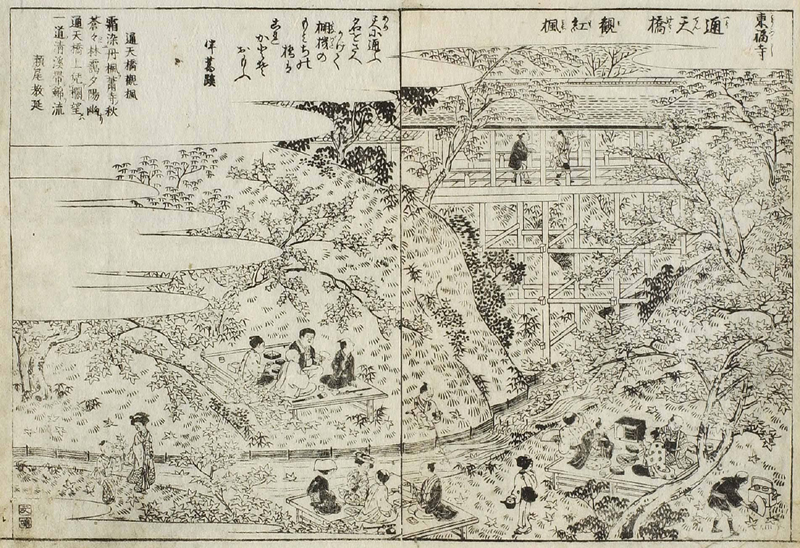
Tsutenkyo 通天橋 Tsuten bridge

source : Miyako Rinsen Meishō Zue

:::::::::::::::::::::::::::::::::::::::::::::::::::::::::::::::::::::::::::::::::::::::::::::::::::

枯山水(かれさんすい)kare sansui
NHK :Bi no Tsubo 美の壷

:::::::::::::::::::::::::::::::::::::::::::::::::::::::::::::::::::::::::::::::::::::::::::::::::::

quote
In the garden of Shigemori's mind
By SACHIKO TAMASHIGE

The Zen gardens of Kyoto have attracted countless admirers and served as inspiration to many artists, designers and other creative people. Steve Jobs, for whom Zen Buddhism was an inspiration, praised Kyoto's gardens, and the minimalism of Zen aesthetics became a strong inspiration behind the design of Apple Inc. products.

The association of a traditional, disciplined minimalism with Japanese rock gardens, such as that of Kyoto's Ryoanji temple, has become so familiar worldwide, it is virtually a cliche. But there are also great examples of Japanese gardens that go beyond traditionalism to provide tranquility and space for contemplation.

Mirei Shigemori (1896-1975), a self-taught garden designer and historian of Japanese gardens, challenged the conventional design of Japanese gardens. He refused to imitate the style of a specific master or school of landscape gardening — a way of teaching that in Japan was common to traditional art and craft forms such as painting, ikebana or pottery.

Born in the Kayo, Jobo District, Okayama Prefecture — where he grew up surrounded by the grand landscapes of Goukei ravine, which remained an inspiration throughout his life — Shigemori moved to Tokyo in 1917 to study nihonga (traditional Japanese-style painting) at the Tokyo School of Fine Arts. To deepen his understanding of Japanese aesthetics, his studies led him to explore a broader spectrum of Japanese culture, including art history, philosophy, calligraphy, the tea ceremony and ikebana.

Instead of pursuing nihonga, however, Shigemori joined the avant-garde debate on ikebana, criticizing the art form and attempting to create a new style of flower arranging. It was around this time that he also became interested in traditional Japanese gardens. Though he had actually completed a garden and tea room on his family's property in 1924 — working on them with his father — it took another 10 years before Shigemori chose to settle on designing gardens as his profession.

After the 1934 Muroto typhoon left a path of destruction across western Japan, Shigemori, worried that more gardens could be lost without a trace in the future, began to survey and document the country's most important ones. Within three years, he researched, measured, photographed and sketched more than 400 gardens, and in 1938 he published the 26-volume "Illustrated Book on the History of the Japanese Garden." It was an unprecedented documentation of Japan's major gardens, which also provided Shigemori with the comprehensive and profound knowledge of landscape gardening that helped his career take off.

Chisao, Mirei Shigemori's grandson, also a garden designer, said in a recent interview that through the extensive research, his father learned that "each significant garden was created with the cutting-edge spirit of the time."

Shigemori's first major work was for Kyoto's Tofuku-ji Temple in 1939. He used geometric shapes and forms in designs for four gardens that are now considered some of the earliest examples of the modern Japanese garden.

"My goal is to create a modern garden, not by replicating traditional gardens of old times," he once said. "But by studying carefully and learning from them."

It was a unique approach from someone who lived in an era when artists in Japan were confronted with the tension between the post Meiji Restoration (1868) modernizing influence of the West and the promotion of Japanese tradition by a growing resistance to such cultural change.

Mirei chose to follow neither Western style nor stick to conventional tradition. Instead, his gardens retained the quintessential element of a Japanese garden — the primordial power that the Shinto tradition attributed to nature — while advocating the modernist spirit.

He designed more than 200 gardens throughout his life, most of which were karesansui (dry landscape or rock gardens).

Nothing can match visiting a Shigemori garden, but Tokyo's Watari Museum of Contemporary Art (Watarium) has found a way to bring Shigemori's garden to the viewer.

As well as a comprehensive visual history of Shigemori's work, including photographs, projections and drawings, three replica sections of the Hassou Gardens of Tofuku-ji have been reproduced as large-scale installations: Hokuto Sichisei (Big Dipper) of the eastern garden, the Eiju and Horai stones of the southern garden and part of the checkered northern garden. For authenticity, each installation has been made to scale — the abstract composition of "Checkered Garden" is even recreated with real moss.

The exhibition also presents some of Shigemori's paintings, calligraphy and interior design work, reminding us that he was a multidisciplinary artist who brought ideas and skills from different disciplines to garden design — something that helped assert gardens as an integral part of the modern art form.

The large film projection of the top floor of the museum, shows viewers other representative works, such as the avant-garde geometric gardens of Kishiwada Castle in Osaka and his prehistoric-inspired garden of Matsunoo-Taisha temple.

Chisao said his grandfather, "focused on the avant-garde garden and devoted himself to the renewal of the garden as art, keeping roots in tradition but relevant to modern life."

The Watarium takes that even further by turning Shigemori's gardens into exhibits outside of their actual location, and giving them the artistic respect that they deserve.
source : Japan Times


. Matsunoo Taisha 松尾大社 Matsunoo Grand Shrine .
Shofu-en 松風苑
Three gardens designed by Mirei Shigemori during the Showa era.

:::::::::::::::::::::::::::::::::::::::::::::::::::::::::::::::::::::::::::::::::::::::::::::::::::


Karesansui 枯山水 (dry landscape gardens, also known as rock gardens and waterless stream gardens) are typically associated with Zen Buddhism, and often found in the front or rear gardens at the residences (houjou 方丈) of Zen abbots. The main elements of karesansui are rocks and sand, with the sea symbolized not by water but by sand raked in patterns that suggest rippling water. Representative examples are the gardens of Ryoanji Temple and Daitokuji Temple, both in Kyoto. Plants are much less important (and sometimes nonexistent) in many karesansui gardens.

Karesansui gardens are often, but not always, meant to be viewed from a single, seated perspective, and the rocks are often associated with and named after various Chinese mountains. The first-ever Zen landscape garden in Japan is credited to Kenchoji Temple in Kamakura. Founded in 1251, this temple was the chief monastery for the five great Zen monasteries that thrived during the Kamakura era (1185-1333). It became the center of Zen Buddhism thanks to strong state patronage.

© Japanese Gardens
Mark Schumacher


:::::::::::::::::::::::::::::::::::::::::::::::::::::::::::::::::::::::::::::::::::::::::::::::::::

Mirei Shigemori (1896–1975), a landscape architect and scholar trained in painting, flower arranging, and tea ceremony, is increasingly admired for his contemporary Japanese garden designs. Believing that the Japanese dry landscape garden (or Zen garden) had fallen into cliché, Shigemori applied modernist shapes, colors, and materials to create stunning avant-garde works that also celebrated the ancient gods and beliefs at the heart of Japanese culture.
http://www.stonebridge.com/SHIGEMORI/shigemori.html

:::::::::::::::::::::::::::::::::::::::::::::::::::::::::::::::::::::::::::::::::::::::::::::::::::


summer in the temple -
the horns of the dragon
just visible


Zen Garden Master Shunmyo Masuno 禅庭氏 増野さん

Daruma Pilgrims in Japan: Kobori Enshuu-

Stone Garden and Haiku

:::::::::::::::::::::::::::::::::::::::::::::::::::::::::::::::::::::::::::::::::::::::::::::::::::::::::::::::::::::::::::

[ . BACK to DARUMA MUSEUM TOP . ]
[ . BACK to WORLDKIGO . TOP . ]

:::::::::::::::::::::::::::::::::::::::::::::::::::::::::::::::::::::::::::::::::::::::::::::::::::::::::::::::::::::::::::

5/30/2007

Dragons of Silk

[ . BACK to DARUMA MUSEUM TOP . ]

:::::::::::::::::::::::::::::::::::::::::::::::::::::::::::::::::::::::::::::::::::::::::::::::::::::

Dragon Gallery

:::::::::::::::::::::::::::::::::::::::::::::::::::::::::::::::::::::::::::::::::::::::::::::::::::::

Dragons of Silk


Dragons of Silk, Flowers of Gold
Textile Treasures of the Chinese Liao Dynasty (907-1125)

Exhibition
29 April – 11 November 2007

The special exhibition reveals the refinement and rich colours of medieval Chinese dress. Woven lions and dragonfish, embroidered flower bouquets and phoenixes decorate boots, trousers, skirts, jackets, coats and the headdress of a lady. Together with exquisite gold-mounted porcelain vessels they lead into a world of luxury and beauty, that accompanied princes of the Liao-Dynasty even in their grave.

© www.abegg-stiftung.ch/


:::::::::::::::::::::::::::::::::::::::::::::::::::::::::::::::::::::::::::::::::::::::::::::::::::::


Pure Silk Handloom Brocade  


 © www.exoticindia.com/


:::::::::::::::::::::::::::::::::::::::::::::::::::::::::::::::::::::::::::::::::::::::::::::::::::::

3/21/2007

Dragon Shopsign

[ . BACK to DARUMA MUSEUM TOP . ]

:::::::::::::::::::::::::::::::::::::::::::::::::::::::::::::::::::::::::::::::::::::::::::::::::::::

Dragon Art Gallery

:::::::::::::::::::::::::::::::::::::::::::::::::::::::::::::::::::::::::::::::::::::::::::::::::::::

Shop Sign

Fish store in Tsuboi Town


Tsuboi Town 坪井宿

- Tsuboi Town Photo Album坪井宿

Izumo Kaido, The Old Road of Izumo 出雲街道


Izumo Kaido Detailed Entries


. Shop signs with DRAGON .

:::::::::::::::::::::::::::::::::::::::::::::::::::::::::::::::::::::::::::::::::::::::::::::::::::::

1/01/2007

DRAGON GALLERY BACKUP 0701

[ . BACK to DARUMA MUSEUM TOP . ]

:::::::::::::::::::::::::::::::::::::::::::::::::::::::::::::::::::::::::::::::::::::::::::::::::::::

DRAGON GALLERY BACKUP 2012 / February

:::::::::::::::::::::::::::::::::::::::::::::::::::::::::::::::::::::::::::::::::::::::::::::::::::::


2012 - the Year of the Dragon - Dragon Year
Das Jahr des Drachen, Jahr des Drachens,
Drachenjahr


Zodiac Animals of Asia, the DRAGON


- - - - - Joys of Japan - - - - -
. Join the Dragon Friends on Facebook .


:::::::::::::::::::::::::::::::::::::::::::::::::::::::::::::::::::::::::::::::::::::::::::::::::::::


The DRAGON has a special place in Asian mythology and art.
Here is a growing collection of articles and artifacts on the subject.

The snake, little brother of the Dragon, will also be dealt with.


:::::::::::::::::::::::::::::::::::::::::::::::::::::::::::::::::::::::::::::::::::::::::::::::::::::

::::::::::::::::::::::::::::::::::::::::::::::::::::::::::::::::::::::::::::::::::::::::::::::::::::

... ... ... ... ... ... ... ... ... ... CONTENTS

... ... ... Articles

Alphabetical List of Dragons, by Kylie McCormick
..... Start from here! With Mythology of World Dragons and more
(external link)


. Amulets and Talismans - Tatsu 辰 Dragon .
clay bells 土鈴, ema votive tablets 絵馬、hariko 張子 papermachee figures

BHUTAN : The Dragon's Gift: The Sacred Arts of Bhutan
February 26 - May 23, 2008

Chinese characters, arranged with DRAGON TAITO たいと

Chinese Dragons by Crystalinks

The Chinese Dragon, by Kate Hunt (Artnet)

Fifth Lucky Dragon, A Fishing Boat Tragedy 第五福竜丸の事件

Gods of the Elements by Gabi Greve

Kagura and the eight-headed serpent Yamata no Orochi by Gabi Greve

Kurikara, the Sword of Fudo Myo-o  by Gabi Greve

Nagarjuna, the Dragon Tree 龍樹 Ryuuju Master Translator

. Nature and Dragon Names .

Ryuujin 龍神, 竜神 Ryujin, the Dragon God
all the details by Mark Schumacher

Ryuuoo 竜王 Ryuo, the Dragon Kings
Hachidai ryuu-oo 八大竜王 Eight Great Dragon Kings
Kairyuu oo kyoo 海龍王経 Sutra of the Dragon King of the Sea


Seiryuu 青龍; 青竜 Seiryu, Azure Dragon in the East
seiryoo, blue dragon, green dragon, Qinglong


. Shrines with Dragon Names .

. Temples with Dragon Names .

.................................................................................


. INFO - Latest Dragon information - .


Check "View by subject" on the right side for more details.


:::::::::::::::::::::::::::::::::::::::::::::::::::::::::::::::::::::::::::::::::::::::::::::::::::::

........ For more Pieces of .. DRAGON .. Art: CLICK HERE !!

:::::::::::::::::::::::::::::::::::::::::::::::::::::::::::::::::::::::::::::::::::::::::::::::::::::

... ... ... Other Dragons

Cherry Tree : The Lying-Dragon Cherry Tree. Garyuuzakura 臥龍桜

Palace, Dragon Palace, ryuuguu 竜宮城

Waterfalls, ryuutaki 龍ヶ滝

:::::::::::::::::::::::::::::::::::::::::::::::::::::::::::::::::::::::::::::::::::::::::::::::::::::

... ... ... Other Animals

Dragonfly (tombo, tonbo) a kigo for haiku

Mandarin Ducks, oshidori 鴛鴦、おしどり

Phoenix in Asian Art

Serpent Festival (Nag Panchami) India
... Snake, serpent, viper, cobra (hebi, mamushi, habu) Japan a kigo for haiku

Tiger, the Four Sleepers, Shisui

Tortoise and Snake (Tsurukame) by Gabi Greve

:::::::::::::::::::::::::::::::::::::::::::::::::::::::::::::::::::::::::::::::::::::::::::::::::::::

... ... ... ... ... LINKS

Some links are at the right sidebar of this BLOG.

More links are here.

:::::::::::::::::::::::::::::::::::::::::::::::::::::::::::::::::::::::::::::::::::::::::::::::::::::


Most interesting material disappears soon from the internet. Here is a series of articles and pieces of art, collected for educational purposes. Proper credit is given at the top of each entry.
Please read the . Copyright Policy . of the Daruma Museum.


For the latest additions check the monthly archives
at the end of the right sidebar of this BLOG.

:::::::::::::::::::::::::::::::::::::::::::::::::::::::::::::::::::::::::::::::::::::::::::::::::::::

Latest Articles of the Daruma Museum

Daruma Museum, Main Gallery

World Kigo Database

:::::::::::::::::::::::::::::::::::::::::::::::::::::::::::::::::::::::::::::::::::::::::::::::::::::


DRAGON GALLERY ... TOP


:::::::::::::::::::::::::::::::::::::::::::::::::::::::::::::::::::::::::::::::::::::::::::::::::::::