Showing posts with label Fudo. Show all posts

2/12/2012

Jinmu Tenno

[ . BACK to DARUMA MUSEUM TOP . ]
:::::::::::::::::::::::::::::::::::::::::::::::::::::::::::::::::::::::::::::::::::::::::::::::::::::

Fudo Myo-O Gallery

:::::::::::::::::::::::::::::::::::::::::::::::::::::::::::::::::::::::::::::::::::::::::::::::::::::

Jinmu Tenno 神武天皇

Emperor Jimmu (神武天皇, Jinmu-tennō) was the first Emperor of Japan, according to the traditional order of succession.
He is also known as
Kamuyamato Iwarehiko no Mikoto (神日本磐余彦尊) and personally as
Wakamikenu no Mikoto (若御毛沼命) or
Sano no Mikoto (狹野尊).


The Imperial house of Japan traditionally based its claim to the throne on its descent from Jimmu. While his accession is traditionally dated to 660 BC, no historically firm dates can be assigned to this early emperor's life or reign, nor to the reigns of his early successors. Most modern historians dismiss this entire period as being beyond what history can know.
The reign of Emperor Kimmei (509?–571 AD), the 29th emperor of Japan according to the traditional order of succession, is the first for which contemporary historiography is able to assign verifiable dates.

Modern scholars question the existence of at least the first nine emperors; and Jimmu's descendant, Emperor Sujin, is the first that, many agree, may have existed, in third or fourth century. Most contemporary historians still agree that it is unlikely that any of the recorded emperors existed until about five hundred years after Suijin's reign and about a millennium after Jimmu's recorded reign. The name Jimmu-tennō was posthumously assigned by later generations.

Archaeologists and historians regard Jimmu as mythical or legendary. In Japanese mythology, the Age of the Gods is the period before Jimmu's accession.

According to Shinto belief,
Jimmu is regarded as a direct descendant of the sun goddess, Amaterasu.
Amaterasu had a son called Ame no Oshihomimi no Mikoto and through him a grandson named Ninigi-no-Mikoto. She sent her grandson to the Japanese islands where he eventually married Konohana-Sakuya-hime.
Among their three sons was Hikohohodemi no Mikoto, also called Yamasachi-hiko, who married Toyotama-hime. She was the daughter of Ryūjin, the Japanese sea god.
They had a single son called Hikonagisa Takeugaya Fukiaezu no Mikoto. The boy was abandoned by his parents at birth and consequently raised by Tamayori-hime, his mother's younger sister. They eventually married and had a total of four sons.
The last of these sons, Kamuyamato Iwarebiko, became Emperor Jimmu.

It is said that, soon after the beginning of Jimmu's reign, a Master of Ceremonies (saishu) was appointed. This office was commonly held by a member of the Nakatomi clan after the eighth century.

Mythic records in the Kojiki and Nihon Shoki tell us that Jimmu's brothers were born in Takachiho, the southern part of Kyūshū (in modern day Miyazaki prefecture), and decided to move eastward, as they found their location inappropriate for reigning over the entire country.
Jimmu's older brother, Itsuse no Mikoto, originally led the migration, and they moved eastward through the Seto Inland Sea with the assistance of local chieftain Sao Netsuhiko.

As they reached Naniwa (modern day Ōsaka), they encountered another local chieftain, Nagasunehiko (lit. "the long-legged man"), and Itsuse was killed in the ensuing battle. Jimmu realized that they had been defeated because they battled eastward against the sun, so he decided to land on the east side of Kii Peninsula and to battle westward.

They reached Kumano, and, with the guidance of a three-legged bird, Yatagarasu (lit. "eight-span crow"), they moved to Yamato.
There, they once again battled Nagasunehiko and were victorious.
© More in the WIKIPEDIA !

:::::::::::::::::::::::::::::::::::::::::::::::::::::::::::::::::::::::::::::::::::::::::::::::::::::


yatagarasu ema  八咫烏絵馬
votive tablet with the three-legged crow
and more details about
. Jinmu Tenno and Kumano .


:::::::::::::::::::::::::::::::::::::::::::::::::::::::::::::::::::::::::::::::::::::::::::::::::::::


Ancestors of Emperor Jimmu


Shared by Taisaku Nogi
Joys of Japan, February 2012


His Mother
Tamayori Hime, Tamayorihime 玉依姫命
. Tamayoribime .


:::::::::::::::::::::::::::::::::::::::::::::::::::::::::::::::::::::::::::::::::::::::::::::::::::::


鵜草葺不合尊 Ugayafukiaezu no mikoto 盧茲草葺不合尊
father of Jinmu Tenno 神武天皇


His Grandfather and Grandmother
Hikohohodemi-no-mikoto (彦火火出見尊)
alias - Yamasachihiko (山幸彦)
and
Toyotama-hime (豊玉姫)

The Wakasa Wedding
Wakasahiko Jinja (若狭彦神社)
Wakasahime Jinja (若狭姫神社)
. Yama no Sachi, Umi no Sachi .


Toyotama-hime 豊玉姫 "Luminous Pearl Princess"
Daughter of the Dragon God Ryuujin 
Watatsumi 海神 "sea god" or Ryūjin 龍神 "dragon god"
was the ruler of seas and oceans。
. Ryujin - the Dragon God .


. The Hata Clan 秦氏 Hata Uji .
and the Korean and Christian connection


:::::::::::::::::::::::::::::::::::::::::::::::::::::::::::::::::::::::::::::::::::::::::::::::::::::

Shrine Miyazaki Jingu 宮崎神宮
established more than 2600 years ago and the oldest in Miyazaki Town.


At Miyazaki Jingu 宮崎神宮

宮の居の流鏑馬凛凛し神武天皇忌
miya no i no yabusame ririshi Jinmu Tennoo ki

the gallant figures
at the Shrine Yabusame -
Jinmu Memorial Day


Yoshi Yoshi
source : shashin-haiku.jp

This shrine is dedicated to Jinmu Tenno.
His old name here is
神日本磐余彦天皇(かんやまといわれひこのすめらみこと)
Kan Yamato Iwarehiko no Sumera Mikoto


Kozasuke omamori 子授け御守 amulet to get pregnant
- Reference - Miyazaki Shrine -

. Regional Folk Toys from Japan .

:::::::::::::::::::::::::::::::::::::::::::::::::::::::::::::::::::::::::::::::::::::::::::::::::::::


この写真は4月3日の神武天皇祭に
本庄市児玉町小平の日本神社で撮ったものです。
Taken at Nihon Jinja at the Jinmu Tenno Festival
This is a shrine in honor of Jinmu Tenno, built in 791 by
Sakanoue Tamura Maro 坂上田村麻呂
This is the only shrine with this name in Japan.
Honjo Town, Saitama (also Ishigami Jinja 石神神社)


In Yamaguchi there is a shrine called
Hinomoto Jinja 日本(ひのもと)神社

source : www.shinge.net


:::::::::::::::::::::::::::::::::::::::::::::::::::::::::::::::::::::::::::::::::::::::::::::::::::::

. Toyotama Hime 豊玉姫 .

. Kagoshima Jingu 鹿児島神宮 Kagoshima Shrine .
built by Jinmu Tenno

. Kirishima Shrine 霧島神宮 .
and the deity Ninigi no Mikoto 瓊瓊杵尊/邇邇芸命

. Ninigi ニニギ and Sakuyahime 花咲屋姫命 .


. Mikenu no Mikoto, Mikenu-no-Mikoto 御毛沼命 .


O-Fudo Sama Gallery


[ . BACK to WORLDKIGO . TOP . ]
[ . BACK to DARUMA MUSEUM TOP . ]
:::::::::::::::::::::::::::::::::::::::::::::::::::::::::::::::::::::::::::::::::::::::::::::::::::::

11/13/2011

Hotei - Pu-Tai

[ . BACK to Daruma Museum TOP . ]
:::::::::::::::::::::::::::::::::::::::::::::::::::::::::::::::::::::::::::::::::::::::::::::::::::::

Hotei 布袋 Pu-Tai

one of the
Seven Gods of Good Luck 七福神 Shichifukujin 


Yamashina-E Picture
Daruma and YAMASHINA Paintings - Yamashina-E


Benten 弁天
Bishamonten 毘沙門天
Daikoku 大黒
Ebisu 恵比寿
Fukurokujuu 福禄寿
Hotei 布袋
Juroojin 寿老人


. Seven Gods of Good Luck 七福神 Shichifukujin .

.................................................................................


Hotei Kokeshi Wooden Doll
- source : ebay 2016 -


Quote from Mark Schumacher:
The Shichifukujin are an eclectic group of deities from Japan, India, and China. Only one is native to Japan (Ebisu). Three are from India (Daikokuten, Bishamonten, and Benzaiten) and three from China (Hotei, Jurojin, and Fukurokuju).

The mystery of number seven has enraptured the Japanese as well. Ancient Japan was founded around seven districts. In Japanese folklore, there are seven treasures and seven deities of good luck (the topic of this story). Japanese Buddhists believe people are reincarnated only seven times, and seven weeks of mourning are prescribed following death.

The list goes on and on -- the seven ups and eight downs of life (Daruma san, you remember), the seven autumn flowers, the seven spring herbs, the seven types of red pepper, the seven transformations, and the popular 7-5-3 festival held each November for children, in which special Shinto rites are performed to formally welcome girls (age 3) and boys (age 5) into the community. Girls (age 7) are welcomed into womanhood and allowed to wear the obi (decorative sash worn with kimono).

Mark Schumacher has many more details and pictures
. . . Mark Schumacher

Link about these seven deities.
http://www.bookmice.net/darkchilde/japan/jgods.html


:::::::::::::::::::::::::::::::::::::::::::::::::::::::::::::::::::::::::::::::::::::::::::::::::::::


The belief in the seven gods of good luck may have started in the Kamakura period as the belief in Ebisu, who had been introduced from India together with Daikoku and Benten. In the Muromachi period, these three were revered together.
Next from India came Bishamonten and then from China Hotei, Fukurooju and Juroojin.

These seven gods are gathered in one common pilgrimmage for the New Year.
At the beginning of the Edo period Tokugawa Ieyasu started the first set of seven temples from Temple Kanei-Ji in the Ueno area. During the more peaceful time of the seventh Shogun Yoshimune it turned into more of a festivity and tourism and spread over all of Japan.

Nowadays, people visit these temples often as a kind of hiking entertainment or stamp ralley, but it never lost in its popularity.

visiting the temples of the seven gods of good luck
shichifukujin mairi 七福神参り
kigo for the New Year

Saijiki of Ceremonies in Japan


From the Daruma Museum
Seven Gods of Good Luck as Daruma Dolls 七福神だるま


::::::::::::::::::::::::::::::::::::::::::::::::::::::::::::::::::::::::::::::::::::::::::::::::::::: 


source : jugem.jp
Hotei sama 布袋さま


Hotei 布袋 Pu-tai, Bu-Tai, Bu-Dai 布袋

Quoting from my book about Buddha Statues
- Buddhastatuen ... Who is Who

He is the god of contentment and happiness. He is the only one of the seven deities who is modelled after a real person, the Chinese Zen Priest Kaishi (Ki-hi) , who lived around 900 in T'ang China in the Mountain Temple Shimeizan. He wandered around in the country, carrying his few belongings in a big sack. He freely shared his things with people in need and the local children all loved to be around him.

In his free way of life he teaches us to cultivate a mind free of worry and a heart free of wishes, since these are greater treasures than anything else you can carry around in this world.

He is known to be an incarnation of the Bodhisattva Maitreya (Miroku Bosatsu) the Future Buddha.

His iconography is simple:
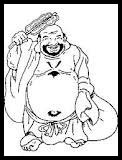
An old, bold man who carries a huge bag. His robe is open and shows his huge belly. Sometimes he holds a Chinese fan (uchiwa) in his hand. Many illustrations show him resting on his huge bag. He is very often represented in Bizen Pottery.


Here you can see him carrying the wishfulfilling jewel and with a child at his side, as quoted by Darkchilde.


. takarabukuro 宝袋 the Treasure Bag of Hotei .


:::::::::::::::::::::::::::::::::::::::::::::::::::::::::::::::::::::::::::::::::::::::::::::::::::::


At the Temple 万福寺 Manpuku-Ji in Kyoto, there is this statue


Hotei is thought to be based on a Chinese monk named Bu-dai, who became identified as an incarnation of Miroku, the Bodhisattva of the future. The statue is kept in the Tenno-den (Heavenly Kings Hall) of the temple.
http://www.art-and-archaeology.com/japan/mampukuji8.html


::::::::::::::::::::::::::::::::::::::::::::::::::::::::::::::::::::::::::::::::::::::::::::::::::::: 


Hotei Daruma on a Stone
石ころに彩色した布袋達磨。 群馬県みなかみ町の“たくみの里”産


© Hisamaro, Seven Goods of Good Luck
七福神グッズいろいろ

::::::::::::::::::::::::::::::::::::::::::::::::::::::::::::::::::::::::::::::::::::::::::::

Here is another version of his legend.


He is the god of happiness, laughter and the wisdom of contentment, and is the patron of the weak and children, fortunetellers and bartenders. Hotei is distinguished by his body of generous proportions and round stomach exposed beneath loose robes. His big belly is a symbol of happiness, luck and generosity. On his back he carrys a huge linen bag containing precious things and gifts of good fortune, including children. He also holds an uchiwa, a flat fan of Chinese orgin used by ancient chieftains as an emblem of authority and wish granting. He may sit in an old cart drawn by boys, as the Wagon Priest, and can be compared with the Buddhistic Mi-lo-Fo.

In Chinese Buddhism he is known as Budai, the Loving or Friendly One. He was a wandering Chan Buddhist monk who lived in the ninth century. At his death between 901 and 903, he recited a poem that revealed to the world that he was in fact the Bodhisattva Maitreya in disguise. Maitreya, Chinese Buddhists believe, is the future buddha, who will return to the world and bring innumerable individuals to salvation. This concept of hope for the suffering, combined with Budai's pleasing, human features, made him a most popular Buddhist deity. It was not until the sixteenth century that he was canonised as the sixteenth and last Chinese bodhisattva.
According to Chinese legend he carried a sack of candy to give to children.

He is sometimes worshipped as a god of good luck and prosperity. He is always represented as very stout, with the breast and upper abdomen exposed to view. His face has a widely grinning or laughing expression, and he is also known as the Laughing Buddha. He stands in the first hall of the Buddhist monastery. Because of his constant good nature, he has become the symbol of philosophical contentment.
http://www.holymtn.com/gods/hotei.htm

:::::::::::::::::::::::::::::::::::::::::::::::::::::::::::::::::::::::::::::::::::::::::::::::::::::


CLICK for more photos !

「布袋の大仏」-The Great Hotei Statue
Aichi prefecture, Konan town 愛知県江南市

- - - The Grandfatherly Buddha of Hotei
Visible from the train between Hotei Station and Konan Stations on the Meitetsu Inuyama Line, the 18m high Hotei Buddha was erected in 1954 by successful local Moxibustion practitioner, Maeda Hidenobu. The Hotei Buddha is popular with travelers on the train line, and with photographers, particularly in spring, when the Buddha is surrounded by clouds of pink cherry blossom.
- source : aichi-now.jp/en/features-

.......................................................................

兵庫県姫路市夢前町寺 Himeji, Sumesakichotera

:::::::::::::::::::::::::::::::::::::::::::::::::::::::::::::::::::::::::::::::::::::::::::::::::::::

Hotei painted by Miyamoto Musashi


Fukuoka Art Museum
布袋見闘鶏図

宮本武蔵は江戸時代前期の剣豪で、二天一流剣法の始祖です。書画にもすぐれた武蔵は、南宋の梁楷の減筆体や海北友松の画風を学び、気迫のこもった水墨画を残しました。この布袋見闘鶏図には、伝・梁楷、海北友松の作品にも同じ図様のものが見られますが、全体的には友松の作品に近いといえます。まさに飛びかからんとしてにらみ合う二羽の鶏を、布袋は悠然と眺めおろしています。この作品の旧蔵者である茶人・松永耳庵は「布袋という絶対者が、争いの絶えない世間を見つめている」と喝破しました。終生戦いの場に身を置いた宮本武蔵が辿りついた境地として見れば、興味は尽きません。
http://www.fukuoka-art-museum.jp/jc/html/jc05/01/hotei.html


More famous paintings of Hotei

By Doi San 土井利位 筆
http://www.city.koga.ibaraki.jp/rekihaku/sekka/1-4.htm


By 黙庵霊淵(?~1345?)
http://www.sumitomo.gr.jp/related/senoku02/ipix/exhibit01.html

:::::::::::::::::::::::::::::::::::::::::::::::::::::::::::::::::::::::::::::::::::::::::::::::::::::

Hotei, being a cheerful, contented Buddhist monk, is a wonderful little icon; where just the appearance can have the ability to cheer anyone up from a bad day. His largely exposed, pot-belly stomach protrudes in front of him as he continues to laugh through never ending time. This familiar looking statue can be found just about anywhere in the world, and maybe better known as
the Laughing Buddha.

The name Hotei actually means "cloth bag" or "glutton."
A legend has it that if a person is to rub his belly, it brings forth wealth, good luck, and prosperity.
from albrecht

:::::::::::::::::::::::::::::::::::::::::::::::::::::::::::::::::::::::::::::::::::::::::::::::::::::


Hotei carrying a lady across the stream

Nishimura Shigenaga 1697-1756

Read more about this deity.
http://www.bookmice.net/darkchilde/japan/jgods.html


:::::::::::::::::::::::::::::::::::::::::::::::::::::::::::::::::::::::::::::::::::::::::::::::::::::


Courtesan and Hotei Smoking on a Veranda in Moonlight
Suzuki Harunobu (1725 – 1770)

:::::::::::::::::::::::::::::::::::::::::::::::::::::::::::::::::::::::::::::::::::::::::::::::::::::


Hotei on a plate made by Kakiemon, Arita.
柿右衛門 色絵布袋図皿
http://www.umakato.jp/tanakamaru/sk_006.html


Another Kutani plate with Hotei

.. //shofu.pref.ishikawa.jp/shofu/intro/

::::::::::::::::::::::::::::::::::::::::::::::::::::::::::::::::::::::::::::::::::::::::::::

. Seven Fushimi dolls of Hotei 布袋  

. . . . .

Read a lot more here in an essay by Jennifer Polden.
... onmarkproductions.com/html- hotei_by_jennifer_polden.htm


::::::::::::::::::::::::::::::::::::::::::::::::::::::::::::::::::::::::::::::::::::::::::::


You can buy a lot of lucky charms with Hotei here:

http://www.luckfactory.com/chinahoteibuddha1.html


source : popeye.sakura.ne.jp...


布袋 土鈴 dorei
Clay bell with Hotei, click for more !


布袋 絵馬 ema
votive tablet with Hotei, click for more !


:::::::::::::::::::::::::::::::::::::::::::::::::::::::::::::::::::::::::::::::::::::::::::::::::::::


. WKD : Hotei aoi ほていあおい Common Water Hyacinth .


:::::::::::::::::::::::::::::::::::::::::::::::::::::::::::::::::::::::::::::::::::::::::::::::::::::
:::::::::::::::::::::::::::::::::::::::::::::::::::::::::::::::::::::::::::::::::::::::::::::::::::::


Die sieben Glücksgötter (Shichi Fukushin)
Besondere Gruppierung "ausländischer" Gottheiten.


Daikokuten, Bishamonten und Benten sind indische Gottheiten, Ebisu ist eine rein japanische Gottheit. Hotei und Fukurokujuu sind chinesischen Ursprungs.

Seit der Muromachi-Zeit besonders von Geschäftsleuten verehrt. Sechs männliche und eine weibliche (Benten) Gottheit. Entweder alle in einem Tempel aufgestellt oder für jede Gottheit ein eigener Tempel, die in den Neujahrstagen alle abgepilgert werden müssen. In einigen Tempeln befinden sich sieben besonders große, auffallend geformte Natursteine, welche die Gottheiten darstel~len.

Oft zusammen auf einem Glücksschiff (takarabune) dargestellt, auf dessen Segel das Schriftzeichen für "Schätze" (takara) steht. Dieses Bild ist besonders am Neujahrsfest glückbringend.

Eventuell aus dem alten Brauch des "Siebenmal Anbeten" (nanado mairi) entstanden, bei dem zum Gionfest in Kyooto an einem Tempel sieben Mal hintereinander ein Gebet gesprochen werden mußte, damit es wirksam wurde. Die Zahl "SIEBEN" ist seit alter Zeit mit Glück verbunden. Es gab auch den Brauch, sieben Statuen des Hotei nebeneinander aufzustellen.
In der Edo-Zeit am 2. Januar legte man sich ein Bild der Glücksgötter unter das Kopfkissen, um einen guten ersten Traum im neuen Jahr zu haben.

Die meisten Gottheiten wurden bei den Ten bereits besprochen, siehe dort.


Hotei
Chinesischer Zenpriester Kaishi (Kihi) des Tempels Shimeizan; lebte in der T'ang-Zeit. Wanderte bettelnd durchs Land, spielte mit den Kindern, trug seine Habe in einem großen Sack mit sich herum. Inkarnation des Miroku Bosatsu. Er lehrte, daß ein Geist frei von Sorgen und ein Herz frei von Wünschen wertvoller sei als alle weltlichen Schätze dieser Erde.

Ikonografie:
Alter, lachender, kahlköpfiger Priester-Schelm. Offene Kleidung, mit herausragendem dickem Bauch. Mit großem Sack, auf dem er oft ausruht; in der Hand einen chinesischen Fächer.


.Buddhastatuen ... Who is Who   

Ein Wegweiser zur Ikonografie
von japanischen Buddhastatuen

Gabi Greve, 1994

:::::::::::::::::::::::::::::::::::::::::::::::::::::::::::::::::::::::::::::::::::::::::::::::::::::

. Matsuo Basho 松尾芭蕉! .
(when Basho was about 45 years old)

On a portrait of Hotei, Basho wrote:

物ほしや袋のうちの月と花
monohoshi ya fukuro no uchi no tsuki to hana

How much I desire !
Inside my little satchel
the moon and flowers


Tr. David Landis Barnhill in Narrow Road to the Interior
- source : Shambhala Publications, Nov 14, 2006-

Another version by Barnhill

so desirable —
inside his satchel
moon and blossoms

source : basho | Haiku | Poetry - Scribd


Basho is pondering about the large sack of Hotei:

I want to have it !
inside his bag there are
the moon and the blossoms


- the autumn moon and the cherry blossoms . . .
symbols for all the good things of the four seasons.

Basho's poem probably refers to this one by
烏丸光弘 Karasuma Mitsuhiro (1579 - 1638)

大空をさしたる指の先にこそ月雪花も秋の紅葉も

.......................................................................


Tsukioka Yoshitoshi (1839-1892)

::::::::::::::::::::::::::::::::::::::::::::::::::::::::::::::::::::::::::::::::::::::::::::::::::::: 


. Folk Toys and the Seven Gods of Good Luck

. Seven Gods of Good Luck 七福神 Shichifukujin .


[ . BACK to WORLDKIGO . TOP . ]
[ . BACK to DARUMA MUSEUM TOP . ]
- #hotei -
:::::::::::::::::::::::::::::::::::::::::::::::::::::::::::::::::::::::::::::::::::::::::::::::::::::

10/26/2011

Agonashi Jizo

[ . BACK to DARUMA MUSEUM TOP . ]
:::::::::::::::::::::::::::::::::::::::::::::::::::::::::::::::::::::::::::::::::::::::::::::::::::::

Fudo Myo-O Gallery

. Jizo Bosatsu 地蔵菩薩 - Kshitigarbha .

:::::::::::::::::::::::::::::::::::::::::::::::::::::::::::::::::::::::::::::::::::::::::::::::::::::

Agonashi Jizo 腮無( あごなし)地蔵
Jizo without a jaw

Jizo without a chin あごなし地蔵尊


隠岐島のあごなし地蔵尊の遷座.
東光院萩の寺 Hagi no Tera, Osaka
大阪府豊中市南桜塚1丁目12番7号

The two figures by the side of Jizo are
Shoozen 掌善(しょうぜん)
Shooaku 掌悪(しょうあく)


Jizo curing a toothace 歯痛平癒

In the year 1870, the temple 伴桂寺 at Oki Island had to close down. The last priest of the temple had been a disciple of the head prist of the Hagi Temple in Osaka, so he gave all his temple treasures to the Hagi Temple, including the statue of the "Jizo without a jaw", made by Ono no Takamura 小野篁(おののたかむら)卿正.
Two years later a special hall was built for the statue,which is a secret statue (hibutsu) and only shown once a year.

ago naoshi 阿古直し ... ago nashi

In the Heian period, 小野篁 Ono no Takamura was exiled to Iki Island.
There he fell in love with the beautiful 阿古那 Akona. When he was allowed to go back to Kyoto, he left her wooden two statues featuring the both of them.
They seemed to help with toothace and were later seen as Jizo Bosatsu.
They also helped with other pain, for example during pregnancy.
Even today, there are many letters of gratitude.
This is a pun with her name, Akona (Agona) and agonashi (no jaw)

. Legends of the Heian Period (794 to 1185) 平安時代の伝説 .

. Ono no Takamura 小野篁 (802 - 852) .


. Agonashi Jizo - Legend from Nagasaki .

source : www.haginotera.or.jp

:::::::::::::::::::::::::::::::::::::::::::::::::::::::::::::::::::::::::::::::::::::::::::::::::::::

The legend from the village of Kanawa
in Omiya Town


Once upon a long long time
far away from this town on the island of Oki, there lived a man who had a painful toothache. For three days, he was crying all day long
"My tooth aces, my tooth aces so much!"
He could not sleep at night and not eat during the day because of the pain.
In the end he pulled out his jaw, threw it away - and died.


But then, how wonderful, he was reborn as a Bodhisattva.

The pious people of Oki Island then made a wooden statue of Jizo without a chin and prayed to it when they got a toothache.

Soon people from far away also came to pray for healing, and as a gift of gratitude placed one nashi pear into a nearby river or lake or the ocean.
(This is a pun on the sound of NASHI, pear, or
NASHI, to have not (a toothache).


One month during the following year, they placed a nashi pear in the water.
And all the nashi pears flow back to Oki Island.

That was all long long ago, and now we come to a story that happened about 160 years ago.


The farmer Hayashi Yasubei from Kanawa 金輪の林安兵衛 went to the wilderness where the Statue was located, hoisted it on his back and carried it all the way to his village, Kanawa, to a little temple. That was in the Year Tenpo 10, on March 24.
So to our day there is a monthly festival at this temple now.
Tenpo 10, by the way, is the year 1841 of the Edo period.


source : www.bunka.pref.mie.


:::::::::::::::::::::::::::::::::::::::::::::::::::::::::::::::::::::::::::::::::::::::::::::::::::::

quote
Glimpses of Unfamiliar Japan
Lafcadio Hearn

I had first heard in Matsue of Agonashi-Jizo, while suffering from one of those toothaches in which the pain appears to be several hundred miles in depth--one of those toothaches which disturb your ideas of space and time. And a friend who sympathised said:

'People who have toothache pray to Agonashi-Jizo. Agonashi-Jizo is in Oki, but Izumo people pray to him. When cured they go to Lake Shinji, to the river, to the sea, or to any running stream, and drop into the water twelve pears (nashi), one for each of the twelve months. And they believe the currents will carry all these to Oki across the sea.

'Now, Agonashi-Jizo means 'Jizo-who-has-no-jaw.'
For it is said that in one of his former lives Jizo had such a toothache in his lower jaw that he tore off his jaw, and threw it away, and died. And he became a Bosatsu. And the people of Oki made a statue of him without a jaw; and all who suffer toothache pray to that Jizo of Oki.'

This story interested me for more than once I had felt a strong desire to do like Agonashi-Jizo, though lacking the necessary courage and indifference to earthly consequences. Moreover, the tradition suggested so humane and profound a comprehension of toothache, and so large a
sympathy with its victims, that I felt myself somewhat consoled.

Nevertheless, I did not go to see Agonashi-Jizo, because I found out there was no longer any Agonashi-Jizo to see. The news was brought one evening by some friends, shizoku of Matsue, who had settled in Oki, a young police officer and his wife. They had walked right across the island to see us, starting before daylight, and crossing no less than thirty-two torrents on their way. The wife, only nineteen, was quite slender and pretty, and did not appear tired by that long rough journey.

What we learned about the famous Jizo was this:
The name Agonashi-Jizo was only a popular corruption of the true name, Agonaoshi-Jizo, or 'Jizo-the-Healer-of-jaws.'
The little temple in which the statue stood had been burned, and the statue along with it, except a fragment of the lower part of the figure, now piously preserved by some old peasant woman. It was impossible to rebuild the temple, as the disestablishment of Buddhism had entirely destroyed the resources of that faith in Oki.
But the peasantry of Tsubamezato had built a little Shinto miya on the sight of the temple, with a torii before it, and people still prayed there to Agonaoshi-Jizo.

This last curious fact reminded me of the little torii I had seen erected before the images of Jizo in the Cave of the Children's Ghosts. Shinto, in these remote districts of the west, now appropriates the popular divinities of Buddhism, just as of old Buddhism used to absorb
the divinities of Shinto in other parts of Japan.
source : www.gramotey.com

:::::::::::::::::::::::::::::::::::::::::::::::::::::::::::::::::::::::::::::::::::::::::::::::::::::


Ago nashi Jizo at temple Koosaiji 広済寺 Kosai-Ji
Saitama, Kawagoe, Kita Town 川越市喜多町に広済寺

If you have no chin, you have no teeth and can not get a toothache.
People who got healed when praying to this statue brought a toothpick made from a willow branch as an offering.
source : www.tabi2ikitai.com


:::::::::::::::::::::::::::::::::::::::::::::::::::::::::::::::::::::::::::::::::::::::::::::::::::::


temple Jikooji 慈光寺 Jiko-Ji of the Kannon Pilgrimage
Saitama
埼玉県比企郡ときがわ町
source : ohenro.blog.ocn.ne.jp


:::::::::::::::::::::::::::::::::::::::::::::::::::::::::::::::::::::::::::::::::::::::::::::::::::::


On a roadside near the river Kakogawa in Hyogo
"so that Jizo can help all people who leave town and seek good fortune".

This Jizo stands in a small wooden hall, with a stone marker by its side.
The chin of the statue is covered by a red big, so we do not know wheather it has a chin or not.
加古川 兵庫
source : www.hyogo-c.ed.jp


:::::::::::::::::::::::::::::::::::::::::::::::::::::::::::::::::::::::::::::::::::::::::::::::::::::


Taikichoo in Mie. 大紀町三重県
source : michihata

. . . CLICK here for more Photos !
.......................................................................


. agonash Jizo アゴなし地蔵 Jizo without a jaw .
大原山 Daigensan - 不動院 Fudo-In, Fukuoka

.......................................................................

More Jizo to help your toothache

. Haitadome Jizo 歯痛止のお地蔵さん .

Hagami Jizo 歯神地蔵尊
Jizo as God for Toothache


:::::::::::::::::::::::::::::::::::::::::::::::::::::::::::::::::::::::::::::::::::::::::::::::::::::


梅雨最中 ずきずき ずきと 歯の痛み
tsuyu sanaka  zukizuki zuki to  ha no itami

long rainy season -
splitting splitting splitting
my tooth aches


. Gabi Greve, 2006 .


the god of toothache -
I wish I was there
to add my coin


In the town of Kathmandu in Nepal there is a God of Toothache at a road corner in Thamel, just a piece of wood shaped like a molar itself. If you have a toothache, you go there and hammer one coin wishing your illness might pass.

. Toothache and Haiku .


:::::::::::::::::::::::::::::::::::::::::::::::::::::::::::::::::::::::::::::::::::::::::::::::::::::

With a map of the location:
source : okinoshima.info

. Reference : Agonashi Jizo


. Jizo Bosatsu 地蔵菩薩 .


O-Fudo Sama Gallery

::::::::::::::::::::::::::::::::::::::::::::::::::::::::::::::::::::::::::::::::::::::::::::::::::::: 

. Amulets and Talismans for your health . 


[ . BACK to WORLDKIGO . TOP . ]
[ . BACK to DARUMA MUSEUM TOP . ]

:::::::::::::::::::::::::::::::::::::::::::::::::::::::::::::::::::::::::::::::::::::::::::::::::::::

9/24/2011

Kotoamatsukami zooka

[ . BACK to DARUMA MUSEUM TOP . ]
:::::::::::::::::::::::::::::::::::::::::::::::::::::::::::::::::::::::::::::::::::::::::::::::::::::

Fudo Myo-O Gallery

:::::::::::::::::::::::::::::::::::::::::::::::::::::::::::::::::::::::::::::::::::::::::::::::::::::

Kotoamatsukami 別天津神

The three deities of creation.

zooka no sanshin 造化の三神
(sanjin)


The three deities of creation and two more on the far sides:

Umashiashikabihikoji no kami 宇摩志阿斯詞備比古遅神
Amenotokotachi no kami 天之常立神
source : risouen


quote
Kotoamatsukami
"Separate heavenly kami," a name referring to the first five kami appearing in the Kojiki. The five include the "three kami of creation" (zōka sanshin), namely
Amenominakanushi no kami,
Takamimusuhi, and
Kamimusuhi no kami,

together with Umashiashikabihikoji no kami and
Amenotokotachi no kami.
The term "separate heavenly kami" originates in Kojiki itself, which states, "The foregoing five kami are the separate heavenly kami." These five kami are characterized by the fact that they came into existence alone (hitorigami), and after coming into being, "hid" themselves. The term kotoamatsukami is not found in Nihongi.
source : Inoue Nobutaka, Kokugakuin 2005


. . . . .

In Japanese Shinto, Kotoamatsukami (別天津神, literally means "distinguishing heavenly kami") is the collective name for the first powers which came into existence at the time of the creation of the universe. They were born in Takamagahara, the world of Heaven at the time of the creation, as Amenominakanushi 天御中主 (Central master), Takamimusubi (High creation), Kamimusubi (Divine creation), and a bit later Umashiashikabihikoji (Energy) and Amenotokotachi (Heaven).

These forces then became gods and goddesses, the tenzai shoshin (heavenly kami) - Ame no minakanushi no kami; Takami-musubi no ôkami; Kamimusubi no ôkami; Umashiashikabihikoji no kami; Ame no Tokotachi no kami; Kuni no Tokotachi no kami; Toyokumono no kami; Uhijini no mikoto; Suhijini no kami; Tsunokuhi no kami; Ikukuhi no kami; Ôtonoji no kami; Ôtonobe no kami; Omodaru no kami; Kashikone no kami; Izanagi no kami; Izanami no kami; and Amaterasu ômikami.
© More in the WIKIPEDIA !

.................................................................................


Ame no minaka nushi no kami
天之御中主神(あめのみなかぬしのかみ)
- 至高の神


Takamimusuhi no kami 高御産巣日神
(たかみむすひのかみ)
- 征服や統治の神


Kami musuhi no kami 神産巣日神(かみむすひのかみ)
- 生産の神


source : facebook

.................................................................................


Amenominakanushi
the first kami to come into being in the Plain of Heaven as a "solitary kami" (hitorigami). He was acknowledged as one of the zōka sanshin ("three kami of creation") and one of the five kotoamatsukami ("separate heavenly deities").
Amenominakanushi
is found at the very beginning of the Kojiki. Amenominakanushi was chief kami of the seven major stars of the constellation Ursa Major. As a result of this influence, Amenominakanushi was made a central deity at the Daikyōin in the early Meiji period. He was also worshipped within sectarian Shinto (kyōha Shintō ).


.................................................................................

quote
Amenominakanushi
Other names: Ame no minakanushi no mikoto(Nihongi)

According to certain of the myths relating the unfolding of heaven and earth, Amenominakanushi was the first kami to come into being in the Plain of Heaven as a "solitary kami" (hitorigami), and to hide his presence. Also counted as one of the zōka sanshin ("three kami of creation") and one of the five kotoamatsukami ("separate heavenly deities"). Amenominakanushi is found at the very beginning of Kojiki, while only appearing in an alternate version within the fourth "alternate writing" quoted in Nihongi.

No mention is made of this kami's activities, and he was not worshiped at any known ancient shrines, with the result that he is considered by some as a kami of abstract character and produced under the influence of Chinese thought.
Kogo shūi states that Takamimusuhi, Kamimusuhi, and Tsuhayamusuhi no kami were all offspring of Amenominakanushi, while Shoku nihongi claims that he was ancestral kami of the Nakatomi clan, and fragmentary records of the Ise no kuni fudoki state that his twelfth-generation descendant was Amenohiwake no mikoto; Shinsen shōjiroku likewise claims him as one of the ancestral deities of certain naturalized clans.

Until the medieval era, Nihongi was considered preeminent to Kojiki, and reference to Amenominakanushi was solely in terms of his role as one of the primeval kami. As students of National Learning (Kokugaku) began to place greater emphasis on Kojiki, however, Amenominakanushi came to be more widely appreciated, and his significance was reevaluated. Hirata Atsutane, in particular, propounded a theology wherein Amenominakanushi was chief kami of the seven major stars of the constellation Ursa Major. As a result of this influence, Amenominakanushi was made a central deity at the Daikyōin in the early Meiji period, and he was worshiped within sectarian Shinto (kyōha Shintō ) as well. During the process of separation of Shinto and Buddhist objects of worship (see shinbutsu bunri), the deity Myoken (the north star) was changed to Amenominakanushi at many shrines.
source : Mori Mizue, Kokugakuin 2005


尊星王像
source : takahashi_hideharu


. Suitengu 水天宮 Shrine for the Water God .
Deity in residence is
Amenominakanushi no kami 天之御中主神
Ame no minaka nushi no kami / 天御中主神


. at shrine Hoshida Jinja 星田神社 Osaka .
Komatsu Jinja 小松神社


. Aoso Jinja 青麻神社 "Green Hemp Shrine" .
Sendai, Miyagi
- Deities in residence:
Amaterasu Omikami 天照大御神 (the sun goddess),
Ame no Minakanushi no Kami 天之御中主神 (the god of the universe), and
Tsukuyomi no Kami 月読神 (the god of the moon)
. . . . hereby the shrine is famous as the place where the sun, the stars and the moon are enshrined together.


:::::::::::::::::::::::::::::::::::::::::::::::::::::::::::::::::::::::::::::::::::::::::::::::::::::

quote
Takamimusuhi
Other names: Takamimusuhi no mikoto(Nihongi),Takagi no kami (Kojiki)

A central kami included in Kojiki's "three kami of creation" (zōka sanshin), and one of the five "separate heavenly kami" (kotoamatsukami). A solitary kami that comes into being after Amenominakanushi, and then "hides away," Takamimusuhi later reappears, together with Amaterasu, as one of the central kami of the Plain of High Heaven (Takamanohara).

Takamimusuhi assembled the conference of heavenly kami that conferred regarding the Descent of the Heavenly Grandchild (tenson kōrin), and he also selected and dispatched messengers to the Central Land of Reed Plains (Ashihara no Nakatsukuni) for the purpose of negotiating for the "transfer of the land" (kuniyuzuri).

Takamimusuhi's daughter was Yorozuhatahime, who in turn was the mother of Ninigi no mikoto; according to the main text of Nihongi, it was imperial ancestor Takamimusuhi no mikoto who invested Ninigi as ruler of the Central Land of Reed Plains. At the time of the descent of the heavenly grandchild, Omoikane and other descendants of Takamimusuhi were assigned to accompany Ninigi upon his descent. Takamimusuhi also sent a large crow (yatakarasu) as aid during Jinmu's eastern expedition, in this and other ways giving protection to the descendants of the heavenly kami. Nihongi notes that in preparation for his enthronement (sokui), Jinmu himself served in the role of priest-medium and took on the identity of Takamimusuhi, who was also later made one of the eight kami served by the priests of the imperial Department of Kami (Jingikan).

Takamimusuhi was also claimed by numerous clans as founding ancestor. The tradition transmitted by Kogo shūi describes Takamimusuhi as the eldest of Amanominakanushi's three children, calling him Sumemutsukamurogi no mikoto, and identifying him as ancestor of the Tomo and Saeki clans. In later ages, Takamimusuhi was also worshiped as a god of matchmaking, based on the association of the musuhi (or musubi) in his name with the same word meaning "to join."
source : Mori Mizue, 2005


:::::::::::::::::::::::::::::::::::::::::::::::::::::::::::::::::::::::::::::::::::::::::::::::::::::

quote
Kamimusuhi
Other names: Kamimusuhi no kami, Kamimusuhi no mioya no kami, Kamimusuhi no mikoto(Kojiki. Nihongi)

According to Kojiki, one of the three kami of creation (zōka sanshin), and classed as one of the "separate heavenly kami" (kotoamatsukami). Kamimusuhi came into being after Takamimusuhi as the third of the five solitary kami (hitorigami), and her presence was not visible. After Ōgetsuhime was murdered by Susanoo, Kamimusuhi, under the name of the mother deity Mioya no mikoto, transformed the grains produced from Ōgetsuhime's body into seed, thus becoming known as the "ancestral deity" of the five grains (see sojin).

While a heavenly deity (amatsukami), Kamimusuhi has strong links to the earthly deities (kunitsukami) of the Izumo tradition, and when Ōnamuchi was burned to death by his brothers, she granted the wish of Ōnamuchi's mother by restoring him to life; Kamimusuhi's child Sukunahikona later assisted Ōnamuchi with the development of the land.

Finally, when Ōkuninushi was enshrined as a condition for the "transfer of the land" (kuniyuzuri), the invocation of Kushiyatama initiating Ōkuninushi's worship included the name "Kamimusuhi no mioya no mikoto." These are the general details transmitted by Kojiki, which includes detailed episodes of the Izumo myths. Nihongi, on the other hand, describes Kamimusuhi only in an "alternate writing" relating the unfolding of heaven and earth, and elsewhere once as the parent of Takuhatachijihime (see Yorozuhatahime). Kogo shūi describes Kamimusuhi as the third child of Amenominakanushi, and the ancestor of the Ki clan.

Based both on the fact that Shinsen shōjiroku describes Kamimusuhi as ancestor of numerous Izumo-related clans, and on the fact that the Izumo fudoki transmits the legend of Kamosu no mikoto, some people have theorized that Kamimusuhi was actually a kami of the Izumo lineage. On the other hand, the mythos also relates that Sukunahikona and Yorozuhatahime were the offspring of Takamimusuhi, and given that mioya is a title attached primarily to female kami, it is likely that Kamimusuhi was anciently considered the spouse of the heavenly deity Takamimusuhi.

Kamimusuhi has strong links to the heavenly kami in other ways as well, as evidenced by her status as first in rank among the eight kami served by the priests of the Jingikan, and the fact that she is treated as a heavenly kami in the "spirit pacification" ritual of chinkonsai.
source : Mori Mizue, 2005


:::::::::::::::::::::::::::::::::::::::::::::::::::::::::::::::::::::::::::::::::::::::::::::::::::::
:::::::::::::::::::::::::::::::::::::::::::::::::::::::::::::::::::::::::::::::::::::::::::::::::::::


zooka, zouka, zōka is also a word used by Matsuo Basho in his haiku theory.
(zooka has a long oo to pronounce properly.)

Basho said

. Oi no Kobumi "Knapsack Notebook" .
Saigyo’s waka, Sogi’s renga, Sesshu’s painting, Rikyu’s tea ceremony – one thread runs through the artistic Ways. And this artistic spirit is to follow zoka, to be a companion to the turning of the four seasons. Nothing one sees is not a flower, nothing one imagines is not the moon. If what is seen is not a flower, one is like a barbarian; if what is imagined is not a flower, one is like a beast. Depart from the barbarian, break away from the beast,
follow zoka, return to zoka.
Tr. Barnhill

造化にしたがひ 造化に帰れ.
"Follow the zooka, return to the zooka."

shizen no chikara, zooka no chikara 自然の力(造化の力)
- the power of the spontaneous, the power of zooka
in
造花随順 zooka zuijun.

shizen  in the times of Basho referred to the "natural, spontaneous state" of things.

- - - - - Basho wrote:
“I saw the masterwork of zôka in the beautiful scenes of mountains, fields and the coast, and following the footprints of devoted travelers who are free of worldly concerns, I came to know the way of a true artist.”
(Kôhon Bashô zenshû, 6:85)
In this passage zôka is not the landscape per se but what has bought it into being; this concept finds its philosophical roots in Daoist thought.
source : Peipei-Qiu - simply-haiku-2011

- - - - - Basho wrote:
"The singular peaks and grotesque mountains vie with each other in their shapes, forming a hair-like dark line and a glimpse of faint green as in a painting. The sounds of the water, the singing of birds, and the green of pines and cedars are extremely exquisite—the beautiful scene demonstrates the perfection of artistry.
How could one not feel joyous for the great accomplishment of zôka!"

- - - - - Peipei-Qiu wrote:
Bashô joyfully sees the beauty of the landscape as the marvelous work of zôka and emphasizes that following zôka—constantly immersing oneself in the embrace of nature, appreciating its beauty, and following its course—is the essential way to maintain aesthetic sensibilities.

By saying that those who follow zôka see nothing but flowers and think of nothing but the moon, Bashô frames the grand premise that following zôka is the precondition of artistic perception: when one follows zôka, one has the artistic sensibility to capture beauty in everything.
His call for “returning to zôka” further suggests that zôka is not only where artistic creativity begins but its ultimate attainment.

It needs to be reiterated that by zôka Bashô does not mean “nature,” as it often has been used in the English translation of Oi no kobumi, but refers instead to a concept derived from the Daoist classics, in which zaohua/zôka, together with ziran (J. shizen 自然 or ji’nen, naturalness and spontaneity), designates the spontaneous operation of the Dao, and sometimes refers to the Dao itself.

source : Basho-and-the-Dao -Peipei-Qiu

..........................................................................


(In English, the misleading spelling zoka is sometimes used.)

zoka, joka 序歌 a waka poem which is read first
zooka, zakka 雑歌 miscellaneous poems

. Chinese background of Japanese Haiku .


quote
Bashō regards kidai as a way to commune with the creative power of nature (zōka). Bashō does not regard kidai as a rule, but rather as a word or keyword establishing a relationship with kokoro (heart, mind).
... Basho also has said, “Even if the word is not traditional kidai, in the case that the word has enough quality to be kidai, do choose it and use it. When you find a new kidai, it will be a great gift for the next generation” (Kyoraishō).
source : Yūki Itō, with Richard Gilbert


reference : zooka


quote
In Yamaoka Genrin's pioneering haibun anthology the Daoism-influenced concept of Japanese zoka (Chinese: Zaohua) already had been given fundamental importance in the creation of haikai:
"If we trust all to the endless power of zoka."

For further info. read Chapter Five,
Following Zoka and Returning to Zoka,
of Basho and the Dao:
the Zhuangzi and the transformation of Haikai

by Peipei Qiu.

source : Chen-ou Liu, Canada


:::::::::::::::::::::::::::::::::::::::::::::::::::::::::::::::::::::::::::::::::::::::::::::::::::::

Michael F. Marra :
The Japanese meaning of a thing, for example, differs greatly from the Western world's understanding of the term.
In the Western educational system, a thing is "something."
Writes Marra,
"Things, the fact that they are (or not), and their articulation in words are definitely central elements in meaning formations."
Marra goes on to say,

"That Japanese languages have two words that are translated as thing:
koto and mono". . .
expertness or absorption in thoughts cannot exist aside from their being (to be an expert or to be absorbed in thoughts) and that such a being is nothing but the koto that makes the movement and the condition of action possible. Whereas mono indicates the content of movement or the content of quietness, koto indicates their being.
The specific being of the content (mono) always presupposes its existence or Being (koto).
The fact (koto) of seeing presupposes that something (mono) must be seen."
source : simplyhaiku.webs.com


:::::::::::::::::::::::::::::::::::::::::::::::::::::::::::::::::::::::::::::::::::::::::::::::::::::

David Landis Barnhill :

In the West we normally think of nature as a collection of things: trees, toads, rocks, etc. Or we may think of it as a place, such as a wilderness area. Zōka, which I translate as “the Creative,” does not refer to either of those. It is the vitality and creativity of nature, its tendency and ability to undergo beautiful and marvelous transformations. It is not a place or collection of things, nor is it something outside nature that is directing it or bringing things into being—thus the translation of “the Creator” is misleading.
Zōka is the ongoing, continuous self-transforming creativity of the natural world.
...
I think Bashō would argue for the inclusion of season words, certainly for the seasonality of haiku poetry in general. A moment in nature is always a moment in a particular season. To really see nature is to see it in a particular season. Of course American haiku is free to evolve according to its own insights, but we should realize how important seasonality is in Japanese poetry and why it is important.
...
But then each religion is itself a mixture.
Zen Buddhism, of course, is highly influenced by Daoism. Neo-Confucianism brings together classical Confucianism, Daoism, and Buddhism. Shinto and Buddhism co-existed and intermingled for most of the last thousand years.
...
The natural/highly cultured poet knows the tradition and knows the old poems and the rules, because they (supposedly) reflect and direct the way to see reality and nature deeply. But you also have to lose yourself.
...
I see infused in Basho's poetry a conglomerate of belief systems that include, besides Zen Buddhism, other sects of Buddhism (Pure Land, etc.), Daoism, Confucianism, Shinto, and shamanic animism practiced by the Ainu.
...
Americans are familiar with about 200 or so of Bashō’ haiku – mostly those in the Imagist tradition.
source : simplyhaiku 2011

The Creative in Basho's View of Nature and Art


For more translations of hokku :
. Matsuo Basho 松尾芭蕉 - Archives of the WKD .

:::::::::::::::::::::::::::::::::::::::::::::::::::::::::::::::::::::::::::::::::::::::::::::::::::::

Haruo Shirane :
Following the creative
The notion of pursuing the 'truth of poetic art' was closely related to zōka, zuijun, 'following the Creative,' an ideal found in Chinese painting theory. Zōka (tsao hua), the Creator or the Creative, sometimes misleadingly translated as 'Nature,' was not a transcendent, anthropomorphic deity (as usually suggested by the term 'creator') but a 'creative spirit' or force that constantly shapes and transforms landscape and nature.
... literally, that which makes things ... the creative force that gave birth to and governs the movement of all things in the universe ...
Basho wrote with regard to the zōka, the Creavive.
Those who practice such arts follow the Creative
and make the four seasons their friends.

source : Traces of Dreams

:::::::::::::::::::::::::::::::::::::::::::::::::::::::::::::::::::::::::::::::::::::::::::::::::::::


:::::::::::::::::::::::::::::::::::::::::::::::::::::::::::::::::::::::::::::::::::::::::::::::::::::

. Myooken Bosatsu 妙見菩薩 Myoken .
Star Shrines, Hoshi Jinja 星神社


O-Fudo Sama Gallery


. shinbutsu 神仏 kami to hotoke .
shinbutsu shūgō 神仏習合 syncretism - shinbutsu bunri 神仏分離 separation


:::::::::::::::::::::::::::::::::::::::::::::::::::::::::::::::::::::::::::::::::::::::::::::::::::::

Kigo and Zooka, zōka 造化 (zoka), the creative force
The creative force was an important abstract aspect of hokku since Matsuo Basho.
Kigo, on the other hand, are a real-life tool to be used when composing traditional Japanese hokku and haiku.

. Kigo use in worldwide haiku .


[ . BACK to WORLDKIGO . TOP . ]
[ . BACK to DARUMA MUSEUM TOP . ]
:::::::::::::::::::::::::::::::::::::::::::::::::::::::::::::::::::::::::::::::::::::::::::::::::::::