. torii 鳥居と伝説 Shrine gate legends .
:::::::::::::::::::::::::::::::::::::::::::::::::::::::::::::::::::::::::::::::::::::::::::::::::::::
Daruma Pilgrims Gallery
:::::::::::::::::::::::::::::::::::::::::::::::::::::::::::::::::::::::::::::::::::::::::::::::::::::
Torii 鳥居
Gate of a Shinto Shrine

source : JAANUS
Also written 鳥栖; 鶏栖. Lit. bird perch. At one time torii were called uefukazu-no-mikado; uefukazu-no-gomon 於上不葺御門 (literally, a roofless gate.) The use of the honorific mi, go 御 allows the conclusion that such a "gate" was associated with Shinto shrines. An open gatelike structure composed of two posts or pillars, (*hashira 柱), connected by a top lintel, *kasagi 笠木. Occasionally the structure was strengthened by a secondary or collateral lintel, *shimagi 島木, attached to the underside of the top lintel with a tie beam, *nuki 貫, placed below the lintels at a distance about equal to the diameter of the pillar. This distance had much greater variation before the 17th century. Exceptions are torii mon such as found at Oomiwa Shrine 大神神社, in Nara prefecture, or at Wakamiya 若宮 of Kasuga Shrine 春日大社, in Nara, which have portals hung between the pillars. Torii are usually erected at all entrances to a Shinto shrine to separate the hallowed precinct from its secular surroundings. They also serve to distinguish Shinto shrines from Buddhist temples. With the rise of Buddhist-Shinto syncretism in the 12th century, Shinto shrines began to appear within the grounds of Buddhist temples. Even then torii were used to mark the entrances to such shrines.
The origin of torii is unclear. Some scholars believe that the form derives from the torana gates found at the four points of the compass in the fence surrounding the Great Stupa at the monastery of Sanchi near Bhopal in central India. Other scholars believe that they are related to the bairou 牌楼 in China or the kousenmon 紅箭門 in Korea. Furthermore, the Chinese kahyou 華表 or 花表 sometimes has been translated into Japanese as torii, but it is quite different. The SHOUKAHITSUYOUKI 匠家必用記 (1775) states that the kahyou is not the same as the Japanese torii. It has generally been accepted that torii were already in use by the late 8c because of information given in RUIJUUJINGIHONGEN 類聚神祇本源, Gathering Material on the Origin of Shinto, compiled in 1320. However, there is reason to doubt its reliability because mention is made of a *haiden 拝殿 which did not exist until the 10c and it was not called a haiden until the late 12th or early 13c. Instead, the IZUMO NO KAMI OOTORI JINJA RUKICHOU 和泉国大鳥神社流記帳, The Inventory of the Properties of Ootori Jinja 大鳥神社 in Izumo dated 922, mid-Heian period, is considered an accurate record and torii are mentioned. Therefore, it is certain torii were common by the mid-Heian period.
There is a possibility that torii originated in Japan. They may have developed slowly beginning in very ancient times before shrine buildings were deemed necessary. First, four posts may have been placed in the four corners of a sacred area and rope tied from one to the other to designate the boundaries separating the sacred from the mundane. The next step would have been to place two taller posts at the center of the most auspicious direction to form an entrance for the priest. Rope would then have been stretched from post top to post top. An example of two pillars connected only by a rope shimenawa 注連縄 can be seen today in front of the worship hall *haiden 拝殿 at Oomiwa Shrine 大神神社, in Nara prefecture. The use of the rope remains a way of denoting a hallowed place.
Eventually, the rope was replaced by a wooden lintel. Because the structure was weak with only one lintel, a tie beam was added somewhat below the lintel and the simplest *shinmei torii 神明鳥居 came into being. The corner posts around the sacred area became true fence posts to support a simple wooden fence itagaki 板垣. Thus, the entire precinct was permanently enclosed. See *kaki 垣 fence. Wood is still commonly used for small torii, and the oldest extant example 1535 is the *ryoubu torii 両部鳥居 at Kubohachiman Shrine, in Yamanashi prefecture.
The oldest example in stone, widely used until recently for its durability, is found at Hachiman Jinja, Yamagata prefecture and dates from around the middle of the 12th c. Occasionally, torii are made with copper sheeting placed over a wooden core. The oldest extant, dated 1455-1457, is a *myoujin type at the temple, Kimpusenji 金峯山寺, in Nara prefecture. Many torii which may have originally been made of wood have been replaced by stone or reinforced concrete.
Although there are an infinite variety of torii named for unique characteristic, or for the name of the shrine itself, basically all torii can be classified under two major categories: those with straight members, shinmei torii 神明鳥居, and those with curved members, *myoujin torii 明神鳥居. In both cases the terms are loosely applied to torii which fit these simple descriptions. However, shinmei and myoujin also refer to specific styles of torii. 1) Torii with straight members: *shinmei torii 神明鳥居; *ise torii 伊勢鳥居; *kasuga torii 春日鳥居; *hachiman torii 八幡鳥居; *kashima torii 鹿島鳥居; *kuroki torii 黒木鳥居. 2) Torii with curved members: myoujin torii 明神鳥居; *inari torii 稲荷鳥居; *sannou torii 山王鳥居; *miwa torii 三輪鳥居; *ryoubu torii 両部鳥居; *mihashira torii, mitsuhashira torii 三柱鳥居. Three famous myoujin type torii with some noticeably unique characteristics are referred to by the name of their shrines: shitennouji ishi torii 四天王寺石鳥居; *usa torii 宇佐鳥居; and *hakozaki torii 筥崎鳥居.
Before the Premodern period (1568-1868), the proportion of parts of torii varied greatly. From the end of the 16th c. general dimensions were prescribed: the diameter of pillars should be about equal to 1/10 the distance from pillar center to pillar center. According to the SHOUMEI 匠明, Five Secret Books for Master Carpenters, (1608) Edo period, the height of the pillar from the ground to the underside of the tie beam must be determined by a square constructed from the edges of the pillars. A circle is then inscribed. The underside of the tie beam coincides with the upper most perimeter of the circle. The projection of the tie beam is calculated by dividing its length into 3rds from pillar center to pillar center. The ends of the tie beams should project 1/3 of that length. The slanted cuts *tasukizumi 襷墨 on the ends of the lintels are determined by a line projected, nagarezumi 投墨, from the bottom center of the pillar to the upper or lower corners, *uwakado 上角 or *shitakado 下門, of the tie beam.
On this link, you find the illustrations to the above text and much more about Japanese Architecture.
source : JAANUS
:::::::::::::::::::::::::::::::::::::::::::::::::::::::::::::::::::::::::::::::::::::::::::::::::::::

Taro Inari shrine in Taura, Asakusa, by moonlight. 1881
浅草田甫太郎稲前
Kobayashi Kiyochika 小林清親(1847-1915)
Shinto Shrines with a Gate (torii, tori-i)
Simplicity was the essence of the earlier Shinto shrines in Japan. The natives believe that the Japanese kami (gods) inhabit all natural phenomena such as volcanoes and rocks; these sacred places were thus marked with only a shimenawa (special plaited rope) and gohei (strips of white paper). The shimenawa will lead one to fences and on to the torii gates, which are now common features of a shrine.
The architecture of these shrines comes in many varieties, but most were developed from storehouses and dwellings of prehistoric Japan. A pair of komainu (stone 'lion') guards the main path leading to the shrine. One will have its mouth open in a roar while the other has its mouth closed.
Read more here
http://www.marimari.com/content/japan/best_of/architecture/main.html
:::::::::::::::::::::::::::::::::::::::::::::::::::::::::::::::::::::::::::::::::::::::::::::::::::::
The mystery of Oiwa
a highly decorated torii

- source : Green Shinto -
:::::::::::::::::::::::::::::::::::::::::::::::::::::::::::::::::::::::::::::::::::::::::::::::::::::
torii kuguri 鳥居潜り walking through a Shinto torii gate
The Torii stands at the border of the sacred compound. Before entering, you stop before the gate and make one deep bow. Be aware that you are now entering a sacred compound and be greatful for this.
The middle part of the access road from the torii to the shrine is reserved for the deities, so you should not walk in the middle. After bowing, proceede to the right or left and pass the gate.
Walk toward the hand-washing basin (手水 choozu) and cleanse hand, mouth and mind.
. mini torii kuguri ミニ鳥居潜り
crawling through a small torii gate .
while making a wish for health, wealth and family.
:::::::::::::::::::::::::::::::::::::::::::::::::::::::::::::::::::::::::::::::::::::::::::::::::::::

. gankake torii 願掛け鳥居
Torii miniature to make a wish .
Fushimi Inari Taisha Shrine 伏見稲荷大社
:::::::::::::::::::::::::::::::::::::::::::::::::::::::::::::::::::::::::::::::::::::::::::::::::::::
Reference : Torii of Japan

Torii in spring
Why would Daruma be interested in Shinto shrines, you ask?
Well, they sell many talismans and amulettes of Daruma san and at some shrines, there is even a Daruma Market during the New Year Days.
:::::::::::::::::::::::::::::::::::::::::::::::::::::::::::::::::::::::::::::::::::::::::::::::::::::

source : facebook
Another use for a torii !
:::::::::::::::::::::::::::::::::::::::::::::::::::::::::::::::::::::::::::::::::::::::::::::::::::::

:::::::::::::::::::::::::::::::::::::::::::::::::::::::::::::::::::::::::::::::::::::::::::::::::::::
- TORII - See my Photo Album
:::::::::::::::::::::::::::::::::::::::::::::::::::::::::::::::::::::::::::::::::::::::::::::::::::::
mihashira torii 三柱鳥居 three-pillar torii
. Konoshima Jinja 木嶋神社 .
and the Korean connectin to the Hata clan (秦氏)
- quote -
Also called mitsubashira torii 三柱鳥居 or sankaku torii 三角鳥居.
A gate-like structure *torii 鳥居, with a third post to form a triangle rather than the usual two posts. The torii has three top lintels *kasagi 笠木, collateral or secondary lintels *shimaki 島木, and tie beams *nuki 貫, all of which are connected to hold the three pillars together.
When viewed directly from any side, the mihashira torii is shaped like an ordinary simple *myoujin torii 明神鳥居. The origin of this torii is unknown. There is only one example on public view located at Uzumasa 太秦, Konoshima Jinja 木島神社 in Kyoto. Shrine records indicate that the torii was restored sometime during the decades between 1716-36 when the shrine building itself was rebuilt after a fire. The torii stands in a pond, and in its center is a pile of stones believed to be the seat of a god. The records also state that the three pillars symbolize the heavens, earth and mankind.
There is also a reference in the record which asserts that this torii had a connection with Nestorianism, Keikyou 景教, an ancient Christian sect which thrived for about 800 years in the Near East and Central Asia. It is possible that the three pillared torii may have had a Christian connotation. In a private garden in Kyoto, also erected in a stream, is a small three pillared torii. The Christian owners maintain that they descend from an ancient lineage of hidden Christians who used this torii during a period when the prohibition of Christianity was strictly enforced: 1616-1868. They declare that the three pillars represent the Christian belief of the Holy Trinity. It cannot be absolutely proven that this was really the origin. Nevertheless, the possibility exists because even the records of the shrine at Uzumasa, claim that the three-pillared torii, among other things, is said to symbolize faith, hope and charity.
- source : JAANUS
:::::::::::::::::::::::::::::::::::::::::::::::::::::::::::::::::::::::::::::::::::::::::::::::::::::::::::::::::::::::::::
Torii are also found at the entrance of sanctuaries dedicated to the group of TEN 天部, the devas, many of them coming as deities from India.
Torii in front of a Benten sanctuary are very popular.
. Benzaiten 弁財天, Benten 弁天 Benzai-Ten .
:::::::::::::::::::::::::::::::::::::::::::::::::::::::::::::::::::::::::::::::::::::::::::::::::::::::::::::::::::::::::::
H A I K U

Torii from Uji Shrine 宇治神社
宇治川に臨む鳥居の飾かな
Ujigawa ni nozomu torii no kazari kana
the decoration
of the shrine gate overlooking
river Ujigawa
Nomura Hakugetsu 野村泊月
(1882 - 1961)
Tr. Gabi Greve
River Uji (called River Yodo, 淀川, Yodogawa in Kyoto) is famous for fishing and the autumn leaves.
It also features in the "Tales of Genji".
:::::::::::::::::::::::::::::::::::::::::::::::::::::::::::::::::::::::::::::::::::::::::::::::::::::
stowing down
river at Torii gate-
lonely goose
river at Torii
lonely goose flaps down;
nude branch welcomes
decaying branch
wailing river at Torri;
hungry goose flaps down
© Aju Mukhopadhyay, India 2009
:::::::::::::::::::::::::::::::::::::::::::::::::::::::::::::::::::::::::::::::::::::::::::::::::::::
. Shrine, Shinto Shrine (jinja) .
Shimenawa 注連縄
. Mon 門 gate of a Buddhist Temple
sanmon 山門 "mountain gate"
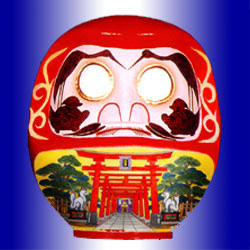
Daruma with Torii on this belly
source : www.mizuho-g.com
- one more ! -
. Daruma plate with torii ! .
Daruma boulder below a torii

source : shizufan.jp
Darumadera in Izu
:::::::::::::::::::::::::::::::::::::::::::::::::::::::::::::::::::::::::::::::::::::::::::::::::::::::::::::::::::::::::::
. torii 鳥居と伝説 Shrine gate legends .
Daruma Pilgrims in Japan
O-Fudo Sama Gallery
[ . BACK to DARUMA MUSEUM TOP . ]
[ . BACK to WORLDKIGO . TOP . ]
:::::::::::::::::::::::::::::::::::::::::::::::::::::::::::::::::::::::::::::::::::::::::::::::::::::::::::::::::::::::::::









 Posts
Posts


