[ . BACK to DARUMA MUSEUM TOP . ]
:::::::::::::::::::::::::::::::::::::::::::::::::::::::::::::::::::::::::::::::::::::::::::::::::::::
Daruma Pilgrims Gallery
:::::::::::::::::::::::::::::::::::::::::::::::::::::::::::::::::::::::::::::::::::::::::::::::::::::
Fishing Methods in Japan
. FISHING METHODS as KIGO
A lot have been discussed, as they are kigo for haiku.
Here I will try and introduce more local methods, which are not kigo.
in ABC order of the Japanese.
:::::::::::::::::::::::::::::::::::::::::::::::::::::::::::::::::::::::::::::::::::::::::::::::::::::
hobiki ami ryoo 帆引き網漁
Sail Trawler
fishing trawlers
hobiki sen 帆引き船 boat with sails billowing

This is a special method at Kasumigarua 霞ヶ浦, a large inland sea of Japan.
The sail is huge and should not touch the water when raising it. It takes some strong arms to perform this feast. Once the sail is up, the fishermen can relax and let the wind do the moving.
This method has been abandoned in 1967, until then it was the only method allowed on the lake. But is now revived by the local fishermen as a tourist attraction.
quote
The hobiki-sen use a single, wide rectangular sail and fish by drifting downwind, the sail being used to generate pulling power for the net which is dragged some 60 to 80 meters behind the boat as it travels beam-on (sideways) to the wind and rides crossways up the crests and down the troughs of the waves.
To crew a hobiki-sen in anything but the most balmy breezes takes great skill in handling the sail and spar to prevent capsizing, and indeed many boats did turn turtle until their crews gained experience.
Conversely, in the case of too much wind or none, the boats simply did not go out. The main targeted species of the hobiki-sen fishermen were whitebait(shirauo) and freshwater smelt (wakasagi). The latter were boiled in brine and dried in the sun before being sold to the fishmongers.
source : educationinjapan.wordpress.com
:::::::::::::::::::::::::::::::::::::::::::::::::::::::::::::::::::::::::::::::::::::::::::::::::::::
ishigamaryoo ishigama ryoo 石がま漁(いしがまりょう)
fishing in artificial stone islands
This is a method used at only during the cold days of winter at the lake Koyama-ike 湖山池(こやまいけ)in Tottori.
It is now practised by only a few and is a designated cultural property of Tottori prefecture.
quote
The
Koyama-ike Pond is located six kilometers west of central Tottori City in eastern Tottori, close to Tottori Airport. It was an inlet of the Sea of Japan, but became a closed lagoon when deposits from the River Sendai-gawa separated it from the sea. There are seven islets in the pond; the largest, Ao-shima, has a park with a nice promenade and camping ground.
This pond, being 4 kilometers long from east to west and 2.4 kilometers wide from north to south, is almost a lake in size and is a sanctuary for eels, carp and other freshwater fish.
They still practice a traditional style of fishing there, called "
Ishigama-ryo," where fishers form a trap with large rocks and wait for the fish to enter.
source : www.jnto.go.jp

This type of fishing takes place on the western side of the lake in
Mitsu 三津地区. It makes use of the habits of the freshwater fish in the lake to hide in rock caves. It is done since 1655, maybe even older and now it is performed as a hobby to preserve the tradition by the local fishermen.
The "stone cauldron" (ishigama 石がま(石釜、石竈)is built up from the bottom of the lake, about 2 meters deep and about 50 cm above the sea level. Inside it is like a labyrinth for the fish to hide, with a final "box" (doobako 胴函 ) to catch them at the end.
In the stone island there are many slots where the fishermen can put in their poles to disturb the fish.
On a fine day from the end of January till mit-Feburary the "master" will decide when the hunt starts. If the island on the other side is clearly visible on the quiet lake, the hunt starts. This means for all the fishermen to be working constantly for the next five to seven hours, poking wooden pine poles of about 6 meters in the holes of the rocks and make noise and small waves, slowly driving the fish to the back of the island.
This is the day of "emptying the cauldron" (kama-age 石がま揚げ」.

While the menfolk stand there in the cold, poking their poles, the womenfolk bring them some food. It is only onigiri rice balls and some side dishes which are cut to long poles, so the men can take a nigiri in one hand and stick one of the food items between the fifth and fourth finger, nibbling on the food as they continue to poke with the other hand, standing in the cold the whole day.
Finally the fish are scooped out of the box. Carp, crucian carp, catfish, eel and pond smelt are the most common.
コイ・フナ・ナマズ・ウナギ・ワカサギ
Once the fish are scooped out, they are put into bags and shared with all the families involved in the day's catch. One catch can bring as much as 100 to 200 kg of fish.
During the active times around 1877, there were more than 85
ishigama in the lake. But after the great earthquake in 1943, most of them were destroyed and never built again. Since 2002, there are initiatives to revive this old fishing method and four
ishigama are revived.. It is always featured in the local TV news.
湖山池石がま漁を伝承する会
Reference : ”石がま漁”
釣好きのちちでありしよ春霞
tsuri-suki no chichi de arishi yo harugasumi
he is for ever
my father, who loves fishing ...
spring haze
Harugasumi
source : 春霞 with more photos
:::::::::::::::::::::::::::::::::::::::::::::::::::::::::::::::::::::::::::::::::::::::::::::::::::::
 kenken gyohoo ケンケン漁法 "kenken fishing"
ケンケン漁
kenkenbune ケンケン船 kenken boats
Small boats, sometimes even with sails, come out with single lines with a lure of small fish and hook, attatched to long poles. Each big fish is caught individually, to perserve its freshness.
They fish for katsuo.
Most famous are the kenken boats from Susami town in Wakayama, すさみのケンケン船.
kenken is said to come from the Hawaian kanaka language, imitating the sound of the fish lure thrown into the water.
:::::::::::::::::::::::::::::::::::::::::::::::::::::::::::::::::::::::::::::::::::::::::::::::::::::
naganawa 長縄 / 延縄 long line fishing
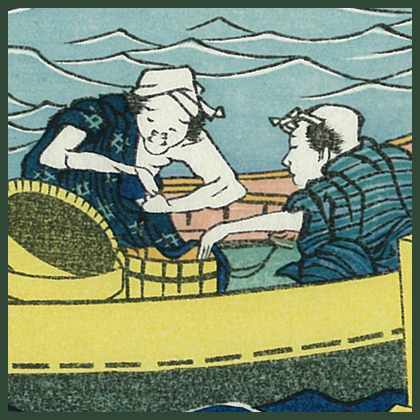 source and full print : adachi-hanga.com/ukiyo-e
宮戸川長縄 Miyatogawa Naganawa
source and full print : adachi-hanga.com/ukiyo-e
宮戸川長縄 Miyatogawa Naganawa
葛飾北斎 千絵の海 Katsushika Hokusai
:::::::::::::::::::::::::::::::::::::::::::::::::::::::::::::::::::::::::::::::::::::::::::::::::::::
tatakiami ryoo たたき網漁
fishing with a net, hitting the surface
On the five lakes near Wakasa in Fukui, 福井県若狭町の三方湖.
三方五湖(みかたごこ)Mikata goko
A couple has to work in great synchronicity.
One rows the boat, the other (the man) now lowers the net into the lake. Then he rows and the wife hits the lake surface with a very long green bamboo pole, cut freshly from the bamboo grove nearby.
Now the woman rows the boat, while the man pulls the net into the boat. Sometimes rather lagre fish are caught this way.
. . . CLICK here for Photos !
:::::::::::::::::::::::::::::::::::::::::::::::::::::::::::::::::::::::::::::::::::::::::::::::::::::
. Utasebune fishing for shrimp
打瀬船 / うたせ船 / 打瀬(うたせ)船
:::::::::::::::::::::::::::::::::::::::::::::::::::::::::::::::::::::::::::::::::::::::::::::::::::::
:::::::::::::::::::::::::::::::::::::::::::::::::::::::::::::::::::::::::::::::::::::::::::::::::::::
. Ships, boats (fune)
Traditional Fishing Tools 釣具 tsurigu
ami あみ【網】fishing net
hikiami, hiki ami ひきあみ【引き網】seine
kabuse ami かぶせあみ【被せ網 / 掩網】cover net
machi ami まちあみ【待ち網】scoop net, waiting for the fish to get in
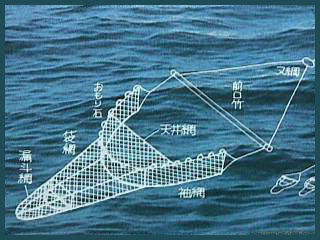
sade ami さであみ【叉手網】scoop net with two arms
sashi ami さしあみ【刺し網】 gill net
sukui ami すくいあみ【掬い網】scoop fishing net
. . . CLICK here for Photos !
. Yakushi Nyorai and the Sukuiami fishing net .
tateami, tate ami たてあみ【立て網】"standing net", fish trap, setnet
toami, to ami とあみ【投網】casting net
..... to-ami o utsu 投網を打つ to cast a fishing net, throw a cast net
yotsude ami よつであみ【四つ手網】four-armed scoop fishing net
.................................................................................
esa えさ【餌】 bait
ikesu 生洲 / 生け簀 fish preserve
. . . CLICK here for ikesu Photos !
. . . . . funa ikesu 船生洲(ふないけす)
fish preserve in a ship
okibari おきばり【置(き)針】 "keeping the hook in place"
A rod or line is placed into the river or pond the evening before. Next morning, fish are caught.
Mostly for eel and catfish.
shizumi しずみ【沈子/ 沈み】 weight, sinker
. . . CLICK here for Photos !
Senker, Gewicht
tsunagizao つなぎざお (繫竿) fishing with many rods
tsuribari つりばり【釣り鉤】 fishhook, fish hook
Fischhaken, Angelhaken
tsuri-ito つりいと【釣(り)糸】 fishing line
tsurizao つりざお【釣り竿】
fishing rod
. . . CLICK here for Photos !
Fischrute, Rute, Angelrute
uki うき【浮子】 float (of a fishing line)
buoy
. . . CLICK here for Photos !
zaotsuri 竿釣り fishing with a rod.
A common pastime of the samurai and richer merchants in Edo.
:::::::::::::::::::::::::::::::::::::::::::::::::::::::::::::::::::::::::::::::::::::::::::::::::::::::
wazao 和竿 "Japanese fishing rod"
 CLICK for more photos !
- quote
Edo Wazao (Bamboo Fishing Rods) 江戸和竿
■ Traditional Technologies and Techniques
CLICK for more photos !
- quote
Edo Wazao (Bamboo Fishing Rods) 江戸和竿
■ Traditional Technologies and Techniques
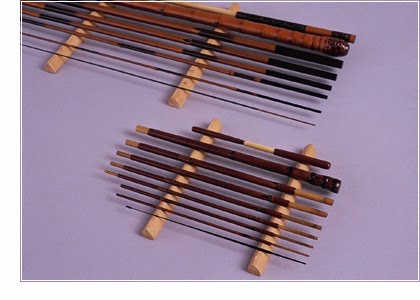
1- The cutting of bamboo stalks and the constructing of Edo Wazao (bamboo fishing rods) occurs in accordance with the type of rod the craftsman has in mind. After issues such as rod length and format have been settled, the craftsman selects the appropriate bamboo and staves are cut from it.
2 - The process of bamboo heating (straightening) involves passing the material through a flame, removing oil from the cane, and making it pliant and straight.
3- Fitting together the sections of a rod created from bamboo staves involves finishing the spigot joints to ensure there is no play in them. There are two types of joints used in Wazao, ferrule joints and telescopic joints.
4- Urushi 塗り (lacquering) is done using refined lacquer.
 ■ Traditionally Used Raw Materials
Bamboo
The twine used at the mouth of spigot joints is silk thread.
Natural lacquer is used for lacquering.
■ History and Characteristics
When it comes to traditional Japanese bamboo fishing rods, there are those made from a single piece of bamboo (called
nobezao 延べ竿 in Japanese), and those constructed by connecting together by spigot joints sections originating from numerous bamboo staves (called
tsugizao 継竿 in Japanese). According to oral history, it is said that “at the end of the Heian Period, in the fourth year of the Jisho Era (1180), tsugizao were developed in Kyoto”. However, there is no documentary evidence to support this claim.
Then again, with regard to Kyoto being the supposed birthplace of tsugizao, in a haiku poetry commentary published in the early Edo Period in the third year of the Enpo Era (1675), there is reference to a bamboo fishing rod called an
irekozao いれこ竿.
Meanwhile, the birth of the tsugizao in Edo is believed to have occurred during the Kyoho Era (1718-1735) somewhat later than in Kyoto. It is often said that a shop called “
Taichiyatosaku”泰地屋東作 (established in the eighth year of the Tenmei Era (1788)), made significant contributions to the techniques employed when manufacturing bamboo fishing rods.
As an aside, if the backgrounds of current Edo Wazao (bamboo fishing rod) craftsmen are investigated, most can trace their roots back to the first generation of “
Taichiya Tosaku” craftsmen. In terms of what Edo Wazao (bamboo fishing rods) actually are, the term describes a single fishing rod constructed from a number of staves of different bamboo varieties (golden bamboo 布袋竹, arrow bamboo 矢竹, black bamboo 淡竹, timber bamboo 真竹). This is what is called a tsugizao.
The making of Edo Wazao commences with the selection of bamboo staves. Craftsmen visit forests themselves and scrutinize each bamboo pole individually. It is said that maybe among 100 bamboo poles, there are perhaps only one or two specimens whose good quality makes them suitable for Edo Wazao. After the bamboo poles have been selected, they are cut down and allowed to dry out naturally for approximately one month. In order to bring out the qualities of a single rod constructed from golden bamboo, arrow bamboo, black bamboo, and timber bamboo staves; having a
kirikumi 切り組み (a plan for cutting and combining the staves) is perhaps the most important factor. Bamboo selections are made in order to create a rod that is easy to use, it being optimized to the type of fish to be caught, the style of fishing, the fishing location, and the fishing conditions.
Edo Wazao Manufacturing Cooperative Association
- source : www.sangyo-rodo.metro.tokyo.jp/shoko
 江戸和竿職人 - 歴史と技を語る
松本三郎 , かくま つとむ
. shokunin 職人 Edo craftsmen, artisan, Handwerker .
.......................................................................
Fishing as a hobby was quite popular with the ladies of Edo.
The
haze 櫨
goby was a special treat of Autumn.
Ukiyo-e tsuri hyakkei 浮世絵つり百景 100 scenes of fishing
 source : gyonet.jp/press
浮世絵つり百景 版画に見る 釣りワールド
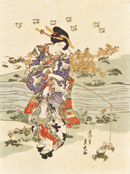
歌川貞虎 「見立三福人 蟹と遊ぶ女
歌川国利 「新板 さかなづくし」
- source : umam.jp/exhibition/tsuri100 - 海の見える杜美術館
Daimyoozuri, Daimyo-Tsuri 大名釣
Fishing as Hobby for Daimyo
He had a lot of servants to help with the petty jobs and could enjoy just to toy with the fish at the rod.

and sometimes the folks were so engaged in fishing, they threw their lines and hit the nose of a fellow fisher . . .

.......................................................................
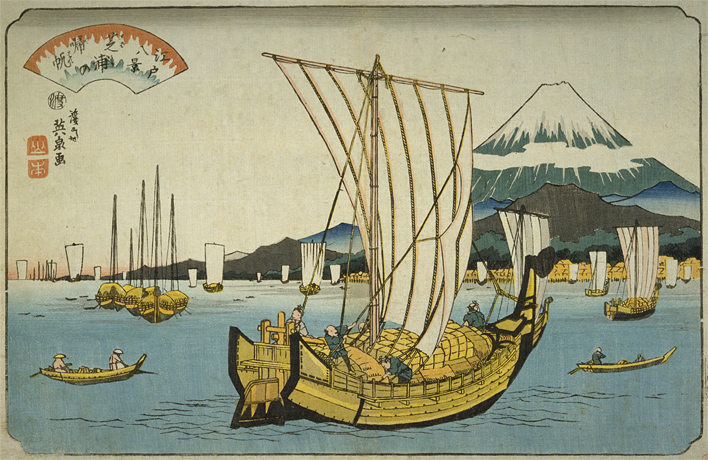
Shibaura 芝浦 Shiba-Ura
 source and photos : ndl.go.jp/landmarks/sights
竹芝浦 (たけしばうら)Take-Shibaura
袖ヶ浦 (そでがうら) Sodegaura
- quote -
Shiba-Ura 芝浦
We have arrived at a small boat landing on the shore of one of the canals in the Shiba district. A friend of mine, Gyotaro, works in this area as a ferry boat pilot. His boat is tied up to the side of the canal, and a group of people are just disembarking from the vessel. He isn't very busy today, and he says he doesn't mind taking us for a ride.
Gyotaro pushes off from the shore, and steers us out into the middle of the canal. There are hundreds of boats passing up and down the canal, carrying every sort of cargo imaginable. The ferries rush by one another just like traffic on a busy city street. However, the ferry boat pilots are very good at steering, and they hardly ever bump into other boats. It takes years of practice to develop the skill, but most of the ferry boat pilots in Edo were practically born on the water, and the steady traffic of boats gliding to and fro on the canals is almost like a ballet.
As we move down the canal towards Edo bay, the channel slowly grows broader, and the tight cluster of row houses gives way to patches of marshland dotted with fishermen's shacks. Along the shore, several small boats drift aimlessly in the shallows, while a group of people nearby wade through the shallows, carrying large wicker baskets. They appear to be collecting shellfish from the mud. This is the fishing village of
Shiba-Ura, which is famous for its delicious seafood. Shiba-Ura is one of the
"
Eight Fishing Villages (Ura) of Edo".
When Tokugawa Ieyasu moved to Edo, one of his first tasks was to ensure that the city had a stable food supply. Of course, one solution was to build lots of new rice fields and irrigation channels. But man can not live on rice alone. So Ieyasu took steps to encourage the fishermen in this area to work harder and catch more fish. At the time, there were only eight fishing villages in the area. Ieyasu gave these eight villages the exclusive right to sell seafood to the Bakufu (government). This was a great incentive, because the Shogun's officials pay higher prices for the best fish. In addition, once the common people find out what the Shogun is going to have for dinner, they often pay higher prices to buy the same type of seafood themselves. The fishermen of these eight villages started to make much better profits selling fish, so they worked twice as hard to increase their catch.
Fishing in Edo Bay increased dramatically over the next few years. The Bay is a rich source of all kinds of fish and other seafood, and the products sold by the "Eight Fishing Villages of Edo" gained a reputation for top quality. Several of the villages, including Shiba-Ura, are located along the shore of the bay, just in front of Edo. Since "mae" is the Japanese word for "in front of", the seafood caught in this area got the name "
Edo-mae". Edo-mae seafood is the freshest in the city, because it is caught and sold on the same day. As a result, the word "Edo-mae" is a word that now symbolizes the best quality seafood in all of Japan.
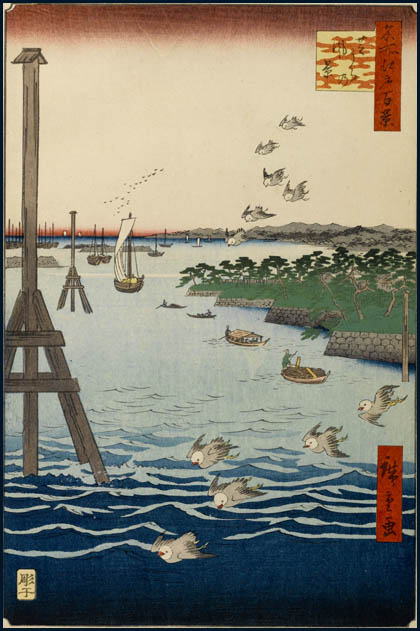
歌川広重 Utagawa Hiroshige
The city of Edo grew rapidly, and it soon became impossible for the eight fishing villages to catch enough fish to satisfy everyone who lived in the city. The Shogun knew he had to increase the supply of seafood, so he asked fishermen from western Japan to move to Edo and build new fishing villages in the "Edo-mae" area. In order to convince people to leave their homes and travel to Edo, the Shogun gave them the right to fish anywhere they wanted to in Edo Bay (in the past, it was customary for people to fish only near their own villages, or out on the open sea). To keep the fishermen in the original eight villages happy, however, he continued the rule that only the original eight ura could sell seafood to the Bakufu.
Gyotaro is from one of the newer villages, located on
Tsukuda Island, which is not far away from here. If you want to learn more about fishing, the best place to go is Tsukuda Island. To get there, though, we have to cross the open waters of the bay. Even as we move out into the bay itself, the sea is almost completely calm. Edo bay is an ideal body of water for fishermen. Although it is a vast expanse of water, filled with many types of seafood, the bay is sheltered from the open sea by two long peninsulas, enclosing it on three sides. Therefore, the waters never get too rough, or the waves too high, except during the fiercest of storms.
Just off shore, there are hundreds of large cargo ships anchored in the bay. These ships carry goods to Edo from all over the country, and even from distant countries like China, Korea and the Ryukyu islands. Demand for products in Edo helps to support the economy of nearly every major town in Japan. Each region is famous for particular products. For example, the western provinces of Nagato and Aki produce some of the finest pottery in the country, while weavers in the Kyoto area are famous for their intricate needlework. Shinano, Hida, and Kai, in central Japan are sources of wood and carved furniture, high-quality stone for building walls and gates, which are transported from the Izu peninsula, while people living in the islands and coastal areas around Shikoku raise tea and fruits such as mikan (tangerines). Ships are costantly entering Edo port from all these regions, carrying a wide variety of goods.
The entire country benefits from trade with Edo, but the ship owners and captains who carry products to the city can make a huge profit if they can bring products that are in high demand. However, the sea voyage to Edo is very risky. Except in the spring and late fall, storms are common, and typhoons can strike without warning in the autumn, sending ships to the bottom of the ocean before they can find a place to land.
There are many stories of traders who have earned their fortune by braving storms and seas to transport valuable cargoes to Edo. One of the most famous of these traders was
Kinokuniya Bunzaemon. He got his start as a small trader in Kii province, and he earned a modest profit transporting the mikan produced in his home region to nearby ports like Ise and Sakai. However, mikan usually get ripe in the late fall or early winter, and that is the time when storms can be most dangerous for ship captains. Even if a ship is not damaged in a storm, high winds can delay it, and by the time it gets to Edo all the tangerines will be rotten.
However, Kinokuniya decided to take his chances, because he knew he could make a good profit from selling the tangerines in Edo. One year, he purchased several large shiploads of mikan and managed to ship them to Edo just at the start of the New Year's festival (o-shogatsu). Kinokuniya was extremely lucky. For several years in a row his ship managed to make the trip to Edo quickly and safely. Since there was almost nobody else selling mikan in the city, he was able to charge high prices and earn a great profit. Eventually, he saved enough money that he was able to stop taking such a big risk every year. Instead, he switched to transporting less perishable products, such as cotton fabrics and porcelain. Kinokuniya's family now operates one of the biggest merchant groups in Edo.
- source : us-japan.org/edomatsu -
. the Shibaura abattoir .
and the Eta, the untouchables of Edo
. Famous Places and Powerspots of Edo .
:::::::::::::::::::::::::::::::::::::::::::::::::::::::::::::::::::::::::::::::::::::::::::::::::::::
fly fishing フライフィッシング
fishing fly, fishing flies
tsuri ruaa 釣りルアー
luer for fishing
- quote -
Kaga Fishing Flies
 The Maeda family,
 who ruled the Kaga Clan (the present Ishikawa and Toyama areas) in feudal times, promoted river fishing for the physical training of samurais (members of a feudal powerful military class).
Then fishing flies were made with minute feathers that looked like insects flying above the surface of the river. Presently, accessories and pendants are produced by utilizing the delicate manufacturing technique of fishing flies.
- source : kanazawa-tourism.com -
. Ishikawa Folk Art - 石川県 .
:::::::::::::::::::::::::::::::::::::::::::::::::::::::::::::::::::::::::::::::::::::::::::::::::::::
 Dans le haveneau
un kilo de goémon
pour une crevette.
In the shrimping net
one kilo of seaweed
for one shrimp.
- Shared by Patrick Fetu -
Joys of Japan, 2012
:::::::::::::::::::::::::::::::::::::::::::::::::::::::::::::::::::::::::::::::::::::::::::::::::::::
. FISHING ... kigo for all seasons
. WASHOKU : FISH and SEAFOOD SAIJIKI
[ . BACK to DARUMA MUSEUM TOP . ]
[ . BACK to WORLDKIGO . TOP . ]
- #shibaura -
:::::::::::::::::::::::::::::::::::::::::::::::::::::::::::::::::::::::::::::::::::::::::::::::::::::






 Posts
Posts


