12/28/2009

Myo Ho Mountain Kyoto

[ . BACK to DARUMA MUSEUM TOP . ]

:::::::::::::::::::::::::::::::::::::::::::::::::::::::::::::::::::::::::::::::::::::::::::::::::::::

Daruma Pilgrims Gallery

:::::::::::::::::::::::::::::::::::::::::::::::::::::::::::::::::::::::::::::::::::::::::::::::::::::

Myo Ho Mountain
Ho no Yama 法の山
Mountain of the Buddhist Law
妙法の法の山 myoohoo no yama


This is one of the five mountains where the "okuribi" seeing-off fire is lit as a final event for the Obon ancestor ceremonies in Kyoto.

. WKD : Daimonji-Yaki 大文字焼き

Great seeing-off fire in Kyoto

Gozan no Okuribi (五山送り火)
Seeing-off fire at the five mountains


The second fire is the one of the Great Law
Myoohoo no hi 妙法の火

Fire of the Buddhist Law


It takes 125 piles of wood to make the fire of MYO 妙
and 75 piles for the HO 法 ,
myoho is the wonderous Dharma of the Buddha teaching.


These five mountain slopes are popular places for excursions in Kyoto.


The character HO 法 LAW in the mountain slope


"ho no yama", "mountainous heap of laws"
Hōno-yama is a mountain in Hokkaido in the Daisestsu-zan mountain range.


:::::::::::::::::::::::::::::::::::::::::::::::::::::::::::::::::::::::::::::::::::::::::::::::::::::


又の世は蛇になるなと法の山
mata no yo wa hebi ni naru na to hoo no yama

in the next life
do not be reborn as a snake !
Mount Ho-no-Yama (Moutain of the Law)


or

法の山や蛇も浮世を捨衣

法の世や蛇もそつくり捨衣


法の山や蛇も浮世を捨衣
hoo no yama ya hebi mo ukiyo o sute-goromo

Mountain of the Law -
even the snake sheds
its worldly robe


clouds above Hoo-no-yama in Kyoto


夕鐘や雲もつくねる法の山
yuugane ya kumo mo tsukuneru hoo no yama

evening bells -
even the clouds stop briefly
at the Mountain of the Law


or
at Mount Ho-no-Yama/ Mount Nori no Yama

Kobayashi Issa
Tr. Gabi Greve


David Lanoue translates this as
nori no yama ("Mount Dharma"), refers to the grounds or precincts of a Buddhist temple.
http://haikuguy.com/issa/haiku.php?code=354.09b


In this respect, we have the words

法の山 mountain of the law (temple)
法の庭 garden of the law (temple)
法の池 pond of the law (temple)


Matsuo Basho at temple Taimadera
. nori no matsu 法の松 Dharma pine


:::::::::::::::::::::::::::::::::::::::::::::::::::::::::::::::::::::::::::::::::::::::::::::::::::::


千振を採つてはならぬ法の山
senburi o totte wa naranu Hoo no yama

it is forbitten
to pick the green gentian here ...
Mount Ho-no-Yama


Irie Hisa 入江ひさ


法の山清水を鳥と頒ちあふ
Hoo no yama shimizu o tori to akachi-au

Mount Ho-no-Yama / Mountain of the Law -
I share the clear water
with all the birds


Ogawa Kane 小川かん紅


梨喰みてこころ水なす法の山
鍵和田[ゆう]子 武蔵野

法の山眠るに打つて出たる星
赤松[けい]子 白毫

病葉の雨の明るき法の山
勝又一透

花煙草ここらも法の山畑
柴原保佳

source : HAIKUreikuDB
Tr. Gabi Greve


:::::::::::::::::::::::::::::::::::::::::::::::::::::::::::::::::::::::::::::::::::::::::::::::::::::

Daruma Pilgrims in Japan

O-Fudo Sama Gallery

[ . BACK to WORLDKIGO . TOP . ]
::::::::::::::::::::::::::::::::::::::::::::::::::::::::::::::::::::::::::::::::::::::::::::::::::::: 

12/18/2009

Temple Jinmu-Ji

[ . BACK to DARUMA MUSEUM TOP . ]

:::::::::::::::::::::::::::::::::::::::::::::::::::::::::::::::::::::::::::::::::::::::::::::::::::::

Fudo Myo-O Gallery

:::::::::::::::::::::::::::::::::::::::::::::::::::::::::::::::::::::::::::::::::::::::::::::::::::::

Temple Jinmu-Ji 神武寺

CLICK for more photos

医王山 神武寺
神奈川県逗子市
In Zushi City, Kanagawa prefecture
Near the Takatoriyama Hiking Trail 鷹取山.


This wooden sculpture of Fudo Myo-O was made several hundred years ago.
He is standing on a rock with a sword in his right hand, a lasso in his left hand and a flame on his back.


Yakushi Nyorai Buddha of Healing

Gyoki 行基, a venerable priest, founded Jimmuji on top of the Jimmuji Mountain in Zushi city in the 8th century . It has worshipped Yakushi-nyorai 薬師如来 as the principal icon in a deep forest for a long time. Nyorai is a person who has attained Buddhahood. They believe that Yakushi-nyorai saves people from diseases. The statue is sitting on a lotus flower with a smile and a medicine bottle.

The present Yakushi-do was probably built at the end of the16th century. This structure has both Chinese and Japanese styles of building. It is designated as an important cultural property by Kanagawa prefecture.
source : www.city.zushi.kanagawa.jp


:::::::::::::::::::::::::::::::::::::::::::::::::::::::::::::::::::::::::::::::::::::::::::::::::::::

. Daruma Museum
Yakushi Nyorai, the Buddha of Medicine 薬師如来


Daruma Pilgrims in Japan

O-Fudo Sama Gallery

:::::::::::::::::::::::::::::::::::::::::::::::::::::::::::::::::::::::::::::::::::::::::::::::::::::

12/12/2009

Daruma Sanpo

[ . BACK to DARUMA MUSEUM TOP . ]
:::::::::::::::::::::::::::::::::::::::::::::::::::::::::::::::::::::::::::::::::::::::::::::::::::::


[ 達磨散歩]

Daruma and Japanese Culture


Taking a walk through Japanese Culture
with Daruma san as our guide.


The AMIE server has taken care of these Daruma files for a long time, but has closed down at the end of 2009.
I have now recovered all the files and add the new LINKS to my BLOG.

Thank you, Amie and Kyobashi san!

www.amie.or.jp/daruma/daruma-new1.html


On these pages, I will present you information about Daruma san in English. I will try to give you an overview of various topics related to Daruma san. So you can get an understanding of how Daruma san even now influences Japanese art and the lives of Japanese people on an everyday level and learn about folk art, ceramics, festivals and other things as you read along. I am your guide, Gabi Greve, born in Germany, a long-time collector of Daruma artefacts, long-time resident of Japan since 1977 and long-time student of Buddhist art.
Contact me in English, German or Japanese:


Gabi Greve, GokuRakuAn, Okayama, Japan, January 2010


:::::::::::::::::::::::::::::::::::::::::::::::::::::::::::::::::::::::::::::::::::::::::::::::::::::


★ A Visit to Konpira San in Shikoku      春の金毘羅さんと達磨さん
http://darumapilgrim.blogspot.com/2004/12/konpira-san-in-shikoku.html
  
★ Daruma-Hunting in Takamatsu Visiting Temples Nagao-ji and Ookubo-ji  
http://darumadollmuseum.blogspot.com/2004/11/takamatsu-dolls.html

  
★ Daruma-ji ― A Temple in Nishi Izu      達磨寺:西伊豆の散歩  
http://darumapilgrim.blogspot.com/2004/11/daruma-dera-in-nishi-izu.html
    
★ Hoorin-ji ― The Daruma Temple in Kyoto      
法輪寺 : 京都のだるま寺 ― お寺参  
http://darumapilgrim.blogspot.com/2004/11/hoorin-ji-temple-in-kyoto.html

★ Jindai-ji - A Daruma Market and Sanskrit      
深大寺の達磨市と梵字 ― お寺参り
http://darumamuseum.blogspot.com/2010/02/jindai-ji-temple.html


...................................... ABC index

    
    ★ Akubi ― Daruma Yawning  
       あくびの達磨 ― 退屈散歩
http://darumasan.blogspot.com/2004/11/akubi-daruma-yawning.html

    ★ Anzan ― Daruma, Birth and Childrearing
      安産, 子育てと達磨さん
http://darumapilgrim.blogspot.com/2004/12/o-mamori-amulettes-and-talismans.html

    ★ Aritayaki ― Daruma of Arita Pottery
      有田焼と達磨さん ― 焼物散歩
http://darumamuseum.blogspot.com/2010/02/aritayaki.html

    ★ AYAME- Iris Daruma from Kashiwa  
     菖蒲だるま 柏だるま 
http://darumadollmuseum.blogspot.com/2004/11/kashiwa-daruma.html

    ★ Bentoobako ― Lunchbox with Daruma
      だるま 弁当箱 ― 駅弁の散歩
http://darumasan.blogspot.com/2006/08/bentoo-lunchbox.html

    ★ Bizenyaki ― Bizen Pottery and Daruma san
      備前焼とだるまさん ― 焼物散歩
http://darumamuseum.blogspot.com/2010/02/bizenyaki.html

    ★ Byoobu and Tsuitate - Daruma on a Screen
      屏風, 衝立とだるま ― 美術散歩
http://wkdsaijikieuropa.blogspot.com/2007/10/folding-screens.html

    ★ Daruma Ichi - Daruma Markets in Japan
      だるま市, ダルマ市 ― お正月散歩
http://darumadollmuseum.blogspot.com/2004/11/markets-to-sell-daruma.html

    ★ Dorei - Clay Bells with Daruma
      土鈴にだるま ― 玩具散歩
http://darumasan.blogspot.com/2004/12/winter-daruma-clay-bells.html

    ★ ENGI-MONO - Things for Good Luck  
    縁起物とだるま
http://darumasan.blogspot.com/2005/09/engimono-for-good-luck.html

    ★ Floriade in Holland - Daruma at the Flower Show
      オランダのフロリアードと達磨さん― お花の散歩
not to be recovered

    ★ Fushimi Tsuchiningyoo - Clay Dolls from Fushimi
      伏見人形とだるま ― 人形散歩
http://darumadollmuseum.blogspot.com/2004/11/fushimi-clay-dolls.html

    ★ Fusuma - Daruma on a Sliding Door
      襖絵とだるま ― 美術散歩
http://darumamuseum.blogspot.com/2010/02/fusuma.html

    ★ Goshiki Daruma and Color Symbols
      五色だるま ― 色彩散歩
http://darumamuseum.blogspot.com/2010/02/goshiki-five-colors.html


    ★ Haiku and Daruma
      俳句とだるま ― 散歩より吟行
http://darumasan.blogspot.com/2005/12/haiku-and-daruma-san.html

    ★ Hakata Dolls and Daruma
      博多の人形と張子のだるま ― 玩具散歩
http://darumadollmuseum.blogspot.com/2004/11/hakata-dolls.html

    ★ Hibachi - Daruma Brazier to Keep You Warm
      火鉢とだるま ― 寒季散歩
http://darumasan.blogspot.com/2005/11/hibachi.html

    ★ Himeji no Daruma - Daruma from Himeji
      姫路のだるま ― 張子散歩
http://darumadollmuseum.blogspot.com/2004/11/himeji-daruma.html

    ★ Hyootan, Namazu and Daruma - The Gourd, the Catfish and Daruma
      瓢箪、鯰とだるま ― 公案散歩
http://darumamuseum.blogspot.com/2008/06/gourd-hyootan.html

    ★ Ishi (1) - Stones and Daruma
      石とだるまさん(1) ― 自然散歩
http://darumasan.blogspot.com/2006/06/ishi-stones.html

    ★ Ishi (2) - Stones and Daruma
      石とだるまさん(2) ― 磨崖仏散歩
http://www.fudosama.blogspot.com/2006/06/magaibutsu.html

    ★ Jimotsu - What is Daruma holding?
      持物 ― 達磨さんがなにを持っていますか?
http://darumamuseum.blogspot.com/2010/02/jimotsu-what-is-daruma-holding.html


    ★ Kakebotoke - Votive Plaques and Daruma
      懸仏と達磨 ― 古美術散歩
http://darumamuseum.blogspot.com/2010/02/kakebotoke-votive-plaques.html

    ★ Kamakurabori - Daruma and Laquerware
      鎌倉彫り ― 漆の散歩
http://darumamuseum.blogspot.com/2010/02/kamakurabori.html

    ★ Kanban ― Shop Signs with Daruma
      看板とだるま― 江戸商人の散歩
http://darumasan.blogspot.com/2006/02/kanban.html

    ★ Kasukabe .. Kasugabe - Daruma Dolls from Kasukabe
      春日部だるま ― 張子散歩
http://darumadollmuseum.blogspot.com/2004/11/kasugabe-dolls.html

    ★ Kasuri - Ikat-Weaving with Daruma Patterns
      絣(かすり)とだるまさんの模様
http://darumamuseum.blogspot.com/2008/06/kasuri.html

    ★ Katana (1) - Daruma and the Japanese Sword
      日本刀とだるま― 武芸散歩-1
http://darumamuseum.blogspot.com/2010/02/katana-1-sword.html
    ★ Katana (2) - Tsuba, Menuki, Daruma and the Sword
      刀、鍔、目抜きとだるま― 武芸散歩-2
http://darumamuseum.blogspot.com/2010/02/katana-2-tsuba-menuki.html

    ★ Katsu!! ― Koan and Daruma
      喝と達磨さん ― 公案散歩
http://darumamuseum.blogspot.com/2010/02/katsu-koan.html

    ★ Kimono ― Daruma as Cloth Design
      着物とだるま ― 和服散歩
http://darumasan.blogspot.com/2005/03/kimono-yukata-nagajuban.html

    ★ Koogoo - Daruma as an Incense Container
      香合とだるま ― 香道散歩
http://darumasan.blogspot.com/2005/11/incense-and-daruma.html
    ★ Kooro - Daruma as an Incense Burner
      香炉とだるま ― 香道散歩
http://darumamuseum.blogspot.com/2008/01/incense-burner.html

    ★ Koraku-En and Daruma - An Autumn Walk
      後楽園とだるまさん ― 晩秋の散歩
TEXT ... Backup only

    ★ Kumano and Nachi ― Hunting for Stone Daruma
      熊野と那智のだるま狩り 自然散歩
http://wkdhaikutopics.blogspot.com/2007/05/kumano.html

    ★ Kurashiki and Daruma
      倉敷とだるま ― 晩秋の散歩
TEXT ... Backup only

    ★ Kutaniyaki ― Daruma of Kutani Pottery
      九谷焼と達磨 ― 焼物散歩
http://darumasan.blogspot.com/2006/02/kutaniyaki-pottery.html


    ★ Matsu ― The Pine and Daruma
      松と達磨 ― 古木散歩
http://darumamuseum.blogspot.com/2010/02/matsu-pine.html

    ★ Matsuyama no Hime Daruma - Princess Daruma from Matsuyama
      松山の姫だるま ― 張子散歩
http://darumadollmuseum.blogspot.com/2004/11/matsuyama-princess-daruma.html

    ★ Me-ire - Painting Eyes for Daruma
      達磨の目入れ ― 伝統散歩
http://darumamuseum.blogspot.com/2010/02/me-ire-painting-eyes.html

    ★ Meoto Daruma and Takasago - Daruma and a Happy Couple (Part 1)
      夫婦だるまと高砂 ― 人生散歩
http://darumamuseum.blogspot.com/2010/02/meoto-and-enmusubi.html

    ★ Meoto Daruma, Enmusubi and more Happy Couples  (Part 2)
      夫婦だるま、縁結びだるま ― 人生散歩
http://darumamuseum.blogspot.com/2010/02/meoto-and-enmusubi.html

    ★ Mikawa Daruma, Daruma from Toyokawa and Toyohashi
      三河のだるま達: 豊川人形、豊橋人形 ― 人形散歩
http://darumadollmuseum.blogspot.com/2004/11/mikawa-dolls.html

    ★ Mimikazari ― Daruma and his Earrings
      耳飾りと達磨さん
http://darumamuseum.blogspot.com/2008/07/earrings.html

    ★ MINI Daruma and a Tiny Encyclopedia about Daruma
      ミニミニ辞典 ― 知識散歩
. WHO is Daruma ?


    ★ Nagoya no Daruma - Daruma from Nagoya
      名古屋のだるま― 玩具散歩
http://darumadollmuseum.blogspot.com/2004/11/nagoya-dolls.html

    ★ Nogata Daruma, Tsuyazaki Clay Dolls and Folkart of Fukuoka Prefecture
      直方だるま、津屋崎土人形 ― 福岡県民芸散歩
http://darumadollmuseum.blogspot.com/2004/11/nogata-dolls.html

    ★ Okinawa, Daruma and Folkcraft
      沖縄の達磨 ― 民芸散歩
http://darumadollmuseum.blogspot.com/2004/11/okinawa-dolls.html

    ★ Oribeyaki ― Daruma of Oribe Pottery
      織部焼と達磨 ― 焼物散歩
http://darumamuseum.blogspot.com/2010/02/oribe-pottery.html

    ★ Ryokan san and Tamashima Daruma
      良寛さんと玉 島だるま ― 歴史散歩
http://darumapilgrim.blogspot.com/2006/05/ryokan-san.html


    ★ Sake and Shochu - Ricewine, Schnaps and Daruma
      酒、焼酎と達磨 ― 晩酌散歩
http://darumasan.blogspot.com/2006/12/sake-and-daruma.html

    ★ Santa Claus and Daruma San -Merry Christmas!
      サンタさんとダルマさん ― クリスマス散歩
http://darumamuseum.blogspot.com/2009/12/santa-claus.html

    ★ Sanukibori ― Carving from Sanuki Area in Shikoku
      讃岐彫り 四国の金毘羅さんの名産
http://darumapilgrim.blogspot.com/2004/12/konpira-san-in-shikoku.html

    ★ Sekiri Daruma carrying one sandal
      靴を持っている達磨さん:隻履達磨
http://darumamuseum.blogspot.com/2007/02/sekiri-one-sandal.html

    ★ Senkootate - Daruma as an Incense Stick Holder
      線香立てとだるま ― 香道散歩
http://darumamuseum.blogspot.com/2010/02/senkootate-incense-holder.html

    ★ Suiteki ― Water Dropper, Hiraga Gennai and Daruma
      水滴,平賀源内と達磨 ― 文学散歩
http://darumasan.blogspot.com/2005/11/suiteki.html


    ★ Takamatsu Daruma ― Papermachee Dolls, Clay Dolls and Small Kites
      高松だるま ― 張子、土人形とミニ凧
http://darumadollmuseum.blogspot.com/2004/11/takamatsu-dolls.html

    ★ Takamatsu and Yakuri Daruma
      高松張子、八栗だるま ― 張子散歩
http://darumadollmuseum.blogspot.com/2004/11/yakuri-daruma.html

    ★ Takeda no Hime Daruma - Princess Daruma from Takeda
      竹田の姫だるま ― 張子散歩
http://darumadollmuseum.blogspot.com/2004/11/takeda-princess-daruma.html

    ★ Tako Kites with Daruma Design
      凧にだるま ― 空の散歩
http://darumasan.blogspot.com/2006/02/kites-tako.html

    ★ Tanuk i ― A Badger posing as Daruma
      狸だるま ― 動物散歩
http://darumamuseum.blogspot.com/2007/06/tanuki-scrotum.html

    ★ Te-aburi - Daruma as a Handwarmer
      手あぶりとだるま ― 寒季散歩
http://darumamuseum.blogspot.com/2010/02/teaburi-hand-warmer.html

    ★ Tokkuri ― Drinking Hot Sake with Daruma
      徳利とだるま ― 焼物散歩
http://darumamuseum.blogspot.com/2007/12/sake-flask-tokkuri.html

    ★ Tsurukame ― Crane, Tortoise and Daruma for Good Luck
      鶴亀とだるま― 縁起物散歩
http://darumamuseum.blogspot.com/2010/02/tsurukame.html

    ★ Uto no Hime Daruma - Princess Daruma from Uto
      宇土の姫だるま ― 張子散歩
http://darumadollmuseum.blogspot.com/2004/11/uto-princess-daruma.html

    ★ Wakasa Daruma ― Daruma of Laquer and Agate Stone
      若狭のだるま― 漆と瑪瑙
http://darumasan.blogspot.com/2010/02/wakasa-laquer.html

    ★ Yakimono ― Daruma in Japanese Pottery
http://darumasan.blogspot.com/2006/09/yakimono-pottery.html

    ★ Yakko Daruma ― 奴だるまの津山の花見
http://darumadollmuseum.blogspot.com/2004/11/yakko-daruma.html

    ★ Yukidaruma ― Daruma as a Snowman
      雪だるま― 冬の散歩
http://darumamuseum.blogspot.com/2008/05/snowman-daruma.html

    ★ Yunomi ― Drinking Tea with Daruma
      湯のみとだるまさん― 焼物散歩
http://darumamuseum.blogspot.com/2007/03/cups.html


To the Daruma Discussion Forum 
だるまフォーラムへ
http://groups.yahoo.com/group/Darumasan-Japan/


To the Daruma Photo Album 
だるま写真館へ
http://www.flickr.com/photos/gabigreve2000/sets/

To Musings about Happiness, a Haiku Forum
癒し俳句フォーラムへ
http://groups.yahoo.com/group/happyhaiku/


Checking for DARUMA SANPO,
I found this little one taking its tiger for the new year for a walk !


http://item.rakuten.co.jp/sichiyo/yz-be7766/


::::::::::::::::::::::::::::::::::::::::::::::::::::::::::::::::::::::::::::::::::::::::::::::::::

Daruma Museum . . . NEW ABC INDEX

:::::::::::::::::::::::::::::::::::::::::::::::::::::::::::::::::::::::::::::::::::::::::::::::::::::

12/10/2009

Marishiten Santen

[ . BACK to DARUMA MUSEUM TOP . ]

:::::::::::::::::::::::::::::::::::::::::::::::::::::::::::::::::::::::::::::::::::::::::::::::::::::

Fudo Myo-O Gallery

:::::::::::::::::::::::::::::::::::::::::::::::::::::::::::::::::::::::::::::::::::::::::::::::::::::

Three TEN Deities 三天 santen


Marishiten 摩利支天
Goddess of Wealth and Warriors
see below


Benzaiten 弁財天, Benten 弁天
one of the seven gods of good luck
(and other WATER deities)


Daikoku Ten 大黒天 Daikoku sama
one of the seven gods of good luck


santen mairi 三天参り
visiting temples of these three deities


:::::::::::::::::::::::::::::::::::::::::::::::::::::::::::::::::::::::::::::::::::::::::::::::::::::


Marishiten 摩利支天 (まりしてん) Marishi-Ten
Goddess of Wealth and Warriors

CLICK for original .. est.hi.ho.ne.jp
http://www.est.hi-ho.ne.jp/k_okimura/ziai/saku6.htm


The details about
MARISHITEN 摩利支天
by Mark Schumacher

Marishiten 摩利支天 / JAANUS Encyclopedia


Sanskrit Marici マリーチ. Marici Deva
Maharishi, Marishi
This name signifies a mirage, hot air shimmer.
Marishiten Bosatsu 摩利支天菩薩(まりしてんぼさつ)
Female deity

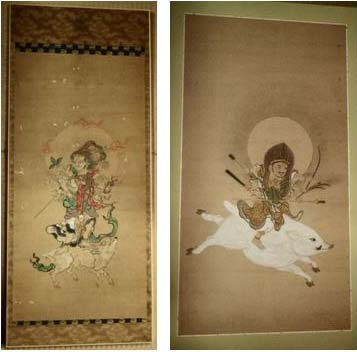
She is sometimes depicted on her boar with a bow in the hand, on tsuba or kozuka, appliances for a Japanese sword.
There was quite a Marishiten cult among the samurai of old.

Marishiten stands on a wild boar (inoshishi).

CLICK for more photos
koma inoshishi 狛猪 temple entrance figures of wild boars


Marishiten shinkoo 摩利支天信仰 worship of Marishi-ten
During the Edo period she was worshipped with Benzaiten (another female deity) and Daikokuten as a bringer of prosperity and wealth for the merchants of Edo.
She is also venerated by the Zen and Nichiren sect and the name is used for one special peak in some mountain ranges.


quote
In Japanese mythology Marishi-ten is known as the goddess of heaven, goddess of light, being a Solar deity. Also known elsewhere as: Marici (Sanskrit), Marisha-Ten and Molichitian (Chinese).

Marishi-ten has historically taken the following depictions

As a beautiful woman sitting on an open lotus
As a ferocious demon perched on the back of a boar
Riding a fiery chariot pulled by seven savage boars or sows
As a multi-armed woman with a different weapon in each hand standing on the back of a boar.
She has been depicted with one, three, five or six faces and two, six, eight, ten or twelve arms; three eyes; in her many-faced manifestations one of her faces is that of a sow.

Bujin Marishi-ten
Marishi-ten, Queen of Heaven, Goddess of the Sun and the Moon was adopted by the Bujin 武人 or Samurai in the 8th century CE as a protector and patron.

While devotions to Marishi-ten predate Zen, they appear to be geared towards a similar meditative mode in order to enable the warrior to achieve a more heightened spiritual level. He lost interest in the issues of victory or defeat (or life and death), thus transcending to a level where he became so empowered that he was freed from his own grasp on mortality. The end result was that he became a better warrior.

The worship of Marishiten was to provide a way to achieve selflessness and compassion through Buddhist training by incorporating a passion for the mastery of the self.

Samurai would invoke a chant Marishiten at sunrise to achieve victory on the battlefield or would invoke Marishiten by other means to attain magical powers that would assist them in battle. An example of the martial characteristic was that Marishiten could provide was the ability to confuse the enemy by preventing them from "seeing," effectively turning the invoker "invisible." Since Marici means "light" or "mirage", she was regarded as the deification of mirages and was thus invisible or difficult to see and was thereby accordingly invoked to escape the notice of one's enemies。
© More in the WIKIPEDIA !


Helmets (kabuto)
The warrior Kusunoki Masashige 楠木正成 (died 1337) had a small statue of Marishiten in the decoration of his helmet. Others say so did Yamamoto Kansuke 山本勘助, Maeda Toshiie 前田利家and other samurai of old. Others used the small figure of a wild boar and the swastika.

Helmet of Uesugi Kagekatsu


The Sutra of Marishiten Bosatsu
摩利支菩薩陀羅尼経


MA , the sacred syllable


The sacred words (spell of Marishiten) are

on marishi ei sowaka
オン マリシエイ ソワカ


Like a mirage hot air shimmer, let me become invisible!


Marishiten appears in various forms in the modern manga.


Reference


:::::::::::::::::::::::::::::::::::::::::::::::::::::::::::::::::::::::::::::::::::::::::::::::::::::


observance kigo for early winter
(the day of the boar in the tenth lunar month)
This is a custom more commen in Western Japan

inoko, i no ko 亥の子 (いのこ) wild boar
i no hi matsuri 亥の日祭(いのひまつり)festival on the day of the boar
i no kami matsuri 亥の神祭(いのかみまつり)festival for the deity of the wild boar

inoko mochi 亥の子餅(いのこもち)rice cakes for the wild boar festival
(also a kigo for late autumn)
They were prepared in the hour of the boar and eaten as a harvest thanksgiving. This a custom coming from China. Here the deity honored is also seen as the God of the Fields (ta no kami).
Many tea masters close the summer hearth on this day.

inoko ishi 亥の子石(いのこいし)stone
inokozuki 亥の子突(いのこづき)
gencho 玄猪(げんちょ)
gogenjoo 御厳重(ごげんじゅう)
..... genshoo 厳祥(げんしょう)
onarikiri おなりきり


................................................................................


tookanya 十日夜 (とおかんや) night of the tenth
(tenth day of the tenth lunar month)
celebrated in Eastern and Northern Japan
(nowadays around November 15)
It was a full-moon day of old.

A harvest thanksgiving celebration for the God of the Fields (ta no kami)


. God of the Fields 田の神 ta no kami  


:::::::::::::::::::::::::::::::::::::::::::::::::::::::::::::::::::::::::::::::::::::::::::::::::::::


2 kigo for the New Year

Marishiten mairi 摩利支天詣(まりしてんまいり)
visiting a temple with the deity Marishiten

hatsu i, hastu-i 初亥 (はつい) first day of the Wild Boar
(according to the Asian lunar calendar)


:::::::::::::::::::::::::::::::::::::::::::::::::::::::::::::::::::::::::::::::::::::::::::::::::::::
:::::::::::::::::::::::::::::::::::::::::::::::::::::::::::::::::::::::::::::::::::::::::::::::::::::


CLICK For original at .. www.iz2.or.jp/gyojibunka/10.html

gencho 玄猪(亥子餅 inoko mochi) wild boar mochi
On the first day of the wild boar, it was customary on the first day of the boar in October to pound rice in a mortar (see illustration above) to make mochi rice cakes to ward off illness for the coming year. The mochi had the form of wild boars.

. WASHOKU
inoko mochi 猪子餅, 亥の子餅

on the 10th day of the 10th month 亥月亥日 
kigo for late autumn


:::::::::::::::::::::::::::::::::::::::::::::::::::::::::::::::::::::::::::::::::::::::::::::::::::::


口すすぐ水満々と初亥の日
kuchi susugu mizu manman to hatsu-i no hi

I rinse my mouth
with a lot of clear water -
first day of the wild boar


Nakajima Hideko 中嶋秀子 (1936 - )

(It is customary to rinse your mouth and wash your hands at a special basin before entering a shrine or temple in Japan.)


:::::::::::::::::::::::::::::::::::::::::::::::::::::::::::::::::::::::::::::::::::::::::::::::::::::


CLICK for more photos


摩利支天の露店の上や春の月
Marishiten no roten no ue ya haru no tsuki

above the shops
at the Marishiten Festival -
the spring moon


Hasegawa Kanajo 長谷川かな女 (1887 - 1969)


Marishiten Festival 摩利支天大祭
at temple Tounji, Tooun-ji 東雲寺, 湖西市
. . . CLICK here for Photos of the temple!


:::::::::::::::::::::::::::::::::::::::::::::::::::::::::::::::::::::::::::::::::::::::::::::::::::::


CLICK for more mountain photos


天騒ぎ摩利支天岳に雷おこる
ten sawagi Marishiten-gake ni rai okoru

heaven is in uproar -
at Mount Marishiten
there is thunder


Mizuhara Shuoshi (Mizuhara Shuuooshi)
水原秋櫻子 (1892 - 1981)


Marishitengake is a peak in the Ontake Mountain range of Kiso 木曽御嶽山
mountain in Nagano, 2959 meters high.
Click on the thumbnail for more photos.


Other peaks of that name are at Norikuradake 乗鞍岳 (Gifu/Nagano) and Kai no Komagatake 甲斐駒ケ岳 (Yamanashi).


CLICK for more stone statues
摩利支天 石仏 Stone statues of Marishi Ten


:::::::::::::::::::::::::::::::::::::::::::::::::::::::::::::::::::::::::::::::::::::::::::::::::::::

There is also a "Temple for the three deities"

santenji Santen-Ji 三天寺

They are
帝釋天 Taishaku-ten
毘沙門天 Bishamon-ten
弁財天 Benzai-ten


These three deities have appeared in a dream to Prince Shotoku Taishi.

The official name of the temple is
帝釈寺 Taishaku-Ji in Osaka.
大阪府箕面市

. . . CLICK here for Photos !


:::::::::::::::::::::::::::::::::::::::::::::::::::::::::::::::::::::::::::::::::::::::::::::::::::::


Daruma and Marishiten Hall Stone Marker
摩利支天堂


CLICK for more photos
at temple Nanzen-Ji 南禅寺, Kyoto


:::::::::::::::::::::::::::::::::::::::::::::::::::::::::::::::::::::::::::::::::::::::::::::::::::::


Takamatsu Hatsumi Sensei

Toshitsugu "Tiger" Takamatsu: (1887-1972)
Considered the last "combat Ninja"

Takamatsu Sensei's Shodo:

"nintai to wa kokoro o yashinai waza o hagemite suenagaku shinken ko so ma no ninja nari"
"the ninja's body is to nurture one's mind and to train the body to endure to the end.
One who can do this is a true ninja."


Paintings by Takamatsu sensei

Marishiten : Buddhist god of war
Daruma san


quote from
http://hatsumi.free.fr/hatsumi-painter-art-work-takamatsu.htm


:::::::::::::::::::::::::::::::::::::::::::::::::::::::::::::::::::::::::::::::::::::::::::::::::::::


Shichi-Fukujin 七福神 Seven Gods of Good Luck

Inoshishi 猪 Wild Boar Papermachee Dolls with DARUMA

Wild Boar (inoshishi) KIGO

Yamamoto Kansuke 山本勘助


:::::::::::::::::::::::::::::::::::::::::::::::::::::::::::::::::::::::::::::::::::::::::::::::::::::
:::::::::::::::::::::::::::::::::::::::::::::::::::::::::::::::::::::::::::::::::::::::::::::::::::::


Marishiten (Maharishi)

Alte indische Gottheit, bewegt sich schneller als das Licht. Ist daher kaum sichtbar, höchstens als Flimmern in der Luft (kageroo). Kann auch von Nitten und Gatten Bosatsu nicht erblickt werden, obwohl er vor ihnen herläuft. Man kann ihn nicht sehen, nicht ergreifen, nicht verbrennen und nicht einfrieren.
Im Kampf wurde er wegen diesen Eigenschaften als besondere Schutzgottheit von den Samurai verehrt.

Ikonografie:
Auf einem Wildschwein stehende Figur.
Mit einem Kopf und zwei Armen oft als weibliche Figur; mit chinesischem Fächer.
Mit drei Köpfen und sechs oder mehr Armen oft als männliche Figur. Chinesischer Fächer in einer Hand, geschwungenes Schwert in einer anderen.
Die meisten buddhistischen Figuren haben ein Schwert mit zwei Schneiden, aber Marishiten hat ein typisch japanisches Schwert mit nur einer Schneide. Er wurde daher von den Samurai besonders verehrt.


.Buddhastatuen ... Who is Who
Ten  天  (Devas)
 

.Buddhastatuen ... Who is Who   

Ein Wegweiser zur Ikonografie
von japanischen Buddhastatuen

Gabi Greve, 1994


:::::::::::::::::::::::::::::::::::::::::::::::::::::::::::::::::::::::::::::::::::::::::::::::::::::

Daruma Pilgrims in Japan
O-Fudo Sama Gallery


[ . BACK to WORLDKIGO . TOP . ]
::::::::::::::::::::::::::::::::::::::::::::::::::::::::::::::::::::::::::::::::::::::::::::::::::::: 

:::::::::::::::::::::::::::::::::::::::::::::::::::::::::::::::::::::::::::::::::::::::::::::::::::::

12/02/2009

Hirayama Ikuo

[ . BACK to DARUMA MUSEUM TOP . ]

:::::::::::::::::::::::::::::::::::::::::::::::::::::::::::::::::::::::::::::::::::::::::::::::::::::

Daruma Pilgrims Gallery

:::::::::::::::::::::::::::::::::::::::::::::::::::::::::::::::::::::::::::::::::::::::::::::::::::::

Hirayama Ikuo 平山郁夫

15 June 1930; died 2 December 2009


We learned of his death today in the news.

While still living in Kamakura, I had the chance to meet him a few times ...

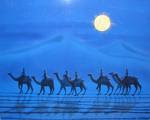
His name is deeply connected with the Silk Road and the Buddha statue of Bamian.

A museum in his honor is here on Ikuchishima island, Setoda town, Hiroshima prefecture.
広島県尾道市瀬戸田町
生口島

. . . CLICK here for Photos !


:::::::::::::::::::::::::::::::::::::::::::::::::::::::::::::::::::::::::::::::::::::::::::::::::::::


quote
Ikuo Hirayama
was a Japanese Nihonga painter. Born in Setoda-chō, Hiroshima Prefecture, he was famous in Japan for Silk Road paintings of desert landscapes in Iran, Iraq, and China.

In 1952, he graduated from the Tokyo School of Art, or what is today's Tokyo National University of Fine Arts and Music (popularly known as "Geidai"), and became a disciple of Maeda Seison. Hirayama also served as President of his alma mater twice (1989-95 and 2001-05).

He produced a series of paintings depicting the introduction of Buddhism to Japan. A victim of the bomb i Hiroshima, he portrayed the A-bomb attack on Hiroshima. He is also active in the preservation of the cultural heritage of the world (e.g., the Bamiyan Buddhas) and is internationally appreciated for his efforts in this sphere. Hirayama was awarded the French Légion d'honneur Order in 1996 and Japan's Order of Cultural Merit in 1998 amongst others.

He had a studio in Kamakura, Kanagawa. There is a dedicated museum in Setoda.
source : wikipedia


CLICK for many more photos CLICK for more photos


English Reference


:::::::::::::::::::::::::::::::::::::::::::::::::::::::::::::::::::::::::::::::::::::::::::::::::::::


Ikuo Hirayama, president of Tokyo National University of Fine Arts and Music, was present when the Northwest University discovery was announced. He commented to the effect that the Japanese student in ancient China must have returned to the present day to remind us to learn from the history of bilateral goodwill and friendship.

Kentoshi 遣唐使Embassies to China


:::::::::::::::::::::::::::::::::::::::::::::::::::::::::::::::::::::::::::::::::::::::::::::::::::::

Daruma Pilgrims in Japan

O-Fudo Sama Gallery

:::::::::::::::::::::::::::::::::::::::::::::::::::::::::::::::::::::::::::::::::::::::::::::::::::::