[ . BACK to DARUMA MUSEUM TOP . ]
:::::::::::::::::::::::::::::::::::::::::::::::::::::::::::::::::::::::::::::::::::::::::::::::::::::
Daruma Pilgrims Gallery
:::::::::::::::::::::::::::::::::::::::::::::::::::::::::::::::::::::::::::::::::::::::::::::::::::::
Priest Tokuitsu 得一 徳溢
 © www.nichiren-etudes.net
Tokuichi, Toku-Itsu
© www.nichiren-etudes.net
Tokuichi, Toku-Itsu
Priest of the Hosso Sect during the Heian Period.
天平宝字4年(760年)? - 承和2年(835年)?)
Tokuichi Bosatsu 徳一菩薩
He stayed at the temple Kofuku-ji in Nara, but then went on to Aizu in Northern Japan, where he practised austerities in the mountains.
In 817, he wrote the tretease: Bussho Sho.
He founded the temple
Enichi-Ji in Aizu, now Enichi-ji 恵日寺 .
会津に慧日寺(えにちじ)を開山した。
This temple burned down but the town of Bandai is trying to rebuild some of the structures.
耶麻郡磐梯町 大字磐梯字寺西38番地
- quote
Enichi-ji Temple was established by Tokuitsu-daishi who diffused Buddhism in Aizu. It is the oldest temple among those whose established ages are identified in Tōhoku region. A plan to reconstruct the temple at the historical site was forwarded, as the ancient Kondō Hall was reestablished in 2008 and has become a symbolic building in Bandai Town.
- source : www.aizu-concierge.com
. Aizu Go Yakushi 会津五薬師 Five Yakushi temples - Enichi-Ji .
Akaidake Yakushi at Temple Jofuku-ji
閼伽井嶽薬師(あかいだけやくし)
赤井嶽薬師
near Iwaki City.
The temple was founded by Tokuitsu Daishi in 806. Yakushi Nyorai, the principal image of the Healing Buddha, was brought from Tang by Genkai Ajari.

:::::::::::::::::::::::::::::::::::::::::::::::::::::::::::::::::::::::::::::::::::::::::::::::::::
Temple Shojo-Ji 勝常寺

One of the oldest Buddhist temples in the Tohoku region, Shojo-ji was founded by
High Priest Tokuichi in 807. The existing "Kodo" Hall, reconstructed in 1398, is known as the "Aizu Central Yakushido." All Buddhist images enshrined here date back to the temple's founding. It is rare that so many early-Heian-period Buddhist images are well preserved at one place.
© www.pref.fukushima.jp
:::::::::::::::::::::::::::::::::::::::::::::::::::::::::::::::::::::::::::::::::::::::::::::::::::::
quote
... the priest
Tokuitsu of Japan. He bitterly criticized the Great Teacher
T'ien-t'ai for rejecting the doctrine of the teachings of the three periods that is set forth in the Profound Secrets Sutra, declaring that T'ien-t'ai had used his three-inch tongue to destroy 116 the Buddha's five-foot body.
The Great Teacher
Dengyo in turn attacked Tokuitsu, pointing out that the Profound Secrets Sutra was first introduced to China by
Hsüan-tsang in the early decades of the T'ang dynasty. In other words, it was brought to the country a number of years after T'ien-t'ai Chih-che, who lived during the Ch'en and Sui, had already passed away.
How then could he have rejected a doctrine that was not introduced to China until the period after his passing?
Faced with such an argument, not only was
Tokuitsu reduced to silence, but his tongue broke into eight pieces, and he died.
© nichiren.info/
:::::::::::::::::::::::::::::::::::::::::::::::::::::::::::::::::::::::::::::::::::::::::::::::::::
Article about
Kukai Kobo Daishi, priest Tokuitsu and the fighting with the Emishi people in the Tohoku region by the imperial government in Kyoto.
East - Enichiji 慧日寺 Enichi-Ji
- quote
ENICHIJI IN THE HEIAN PERIOD
In the absence of written records, we cannot be sure when or by whom Enichiji was established. Its two major founding legends claim that it dates from the beginning of the ninth century; and while temples commonly exaggerate their own antiquity, the discovery of ninth-century pottery in remains of Enichiji buildings suggests that the traditional date is not far off the mark.
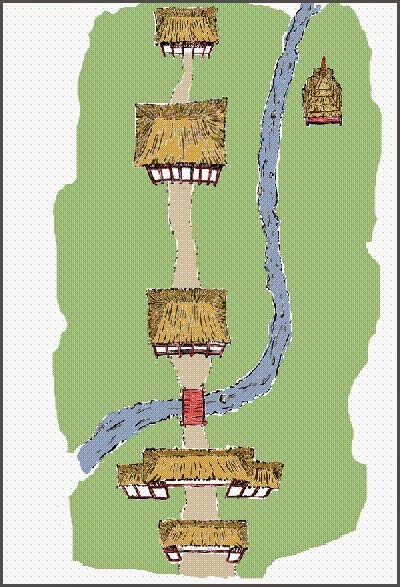
Enichiji's founders, whoever they may have been, built their temple at the foot of Mt. Bandai, a mountain viewed as sacred in local folk belief. The kami (deity) of the mountain was worshipped at BANDAI SHRINE, now located at the site of the Heian temple's central complex.
Under its original name of Iwaki or Iwahashi shrine, it appears in the early tenth-century Engi Shiki as a government-sanctioned institution. By this time it is likely that the shrine and Enichiji had formed a close partnership--a common phenomenon in pre-modern Japan, when "Buddhism" and "Shinto" were not clearly distinguished, and temples and shrines often shared the same precincts.
Enichiji's close relationship to the mountain kami is suggested by one of its two founding legends, an account that appears in the nineteenth-century
Shinpen Aizu Fuudoki. The legend also suggests that the temple was regarded as a holy site that protected the region against illness, famine, and other natural disasters:
At one time an evil spirit lived on Mount Bandai, called at that time the Mountain of Pestilence. The evil spirit destroyed the local rice crops, and if that were not bad enough, a lake suddenly materialized at the foot of the mountain, inundating the houses built there. The imperial court in Kyoto heard about the matter and in 807, dispatched the Shingon Buddhist master Kuukai to reverse the disasters.
For ten days, Kuukai performed an ascetic regimen in a village nearby. His practice drove off the evil spirit. Kuukai then renamed the mountain Bandai, and built a temple at its foot to ward off further disaster. Choosing the exact spot through divination, he constructed the temple, enshrining images of the Buddha YAKUSHI, the bodhisattvas Nikkou and Gakkou, and Buddhist guardian figures--the Four Heavenly Kings and the Twelve Generals. Kuukai was then rewarded with a manifestation of the mountain kami, whom he named Bandai Myoujin (Bandai Myojin).
A more commonly-accepted story claims that the temple was founded in 806 by
TOKUICHI, a monk from the Nara temple Koufukuji who is also credited with establishing several other temples in the area around the same time. The Kuukai legend probably originated in later years, when the temple became affiliated with the Shingon school. We cannot verify Tokuichi's founding role, but a monk or monks from one of Japan's central Buddhist institutions may in fact have established the temple in cooperation with local notables.
Like other provincial Buddhist temples, Enichiji may have been a vehicle for extending government power to remote locations. Wary of religious institutions not under its own control, Japan's imperial government in Kyoto incorporated existing provincial shrines and temples into its own systems, or established new ones to "convert" local people and lay claim to their loyalty. Enichiji was not a large temple in comparison to temples in Kyoto or in Nara, the eighth- century capital; but it was large enough to have been expensive to build. Moreover, the central image of Yakushi at Enichiji's nearby sister temple of SHOUJOUJI, thought to be a twin of Enichiji's central image, is an early Heian figure of great sophistication. The elegance of the gilt-wood image suggests that it was made by skilled artists, perhaps from the same atelier as sculptors of similar images in powerful Kyoto and Nara temples. Although the evidence is very sparse, it points to the involvement of the court or court-sponsored Buddhist institutions in Enichiji's founding.
Another possible source of support was the regional notable class, composed of both indigenous families and officials dispatched by the court who had settled in the area. The conflicts between local families and powerful newcomers were sometimes settled by establishing common religious institutions, where local deities shared space with those who had come from outside. In any case, once Enichiji was established, local support was crucial to its existence. Local histories such as the Fuudoki list lay representatives of the temple who were allocated income from temple holdings at the end of the twelfth century, presumably in return for protecting temple interests. Enichiji's long period of prosperity--at least through the twelfth century and perhaps even longer than that--suggests that local support was quite powerful indeed.
The founding of Enichiji and other Aizu-region temples in the early Heian period may have had a military purpose. During the eighth and ninth centuries, the imperial court made war on the Emishi, people who resisted its control, and pushed them further and further northward. The Emishi fought back fiercely in the Touhoku regions to the north of Aizu.
Tagajou, the capital of Mutsu (Aizu's province), was one center for campaigns against the Emishi. The Aizu region does not seem to have been a battle site, but it supplied the court's armies, and a ninth-century mokkan (record written on a strip of wood) recounts the service of Aizu soldiers at Tagajou. Although armies under the command of the legendary hero Sakanoue Tamuramaro largely brought the Mutsu Emishi under control in the early ninth century, they held out for some time in the province of Dewa, just over the mountains north of Aizu.
Under the circumstances, it must have seemed sensible for the court and their local allies to construct Buddhist temples in strategic regions such as Aizu. For one thing, converting the Emishi to Buddhism helped to pacify them, since Japanese Buddhism was bundled in a cultural package that engendered a peaceful agrarian life and obedience to central authority. In addition, Buddhist temples served as court outposts, often serving local government functions. It may be legend, not fact, that several Aizu temples were founded in the first decade of the ninth century by Tokuichi, a representative of the central power structure. But the kernel of truth in the legend, perhaps, is that central authorities sponsored temple construction in Aizu to shore up government power in a crucial region.
What role did Enichiji play in the political and economic life of the Aizu people? In the absence of definitive evidence we cannot be sure, but several artifacts in the temple's possession--described in Shinpen Aizu Fuudoki but unfortunately now lost--suggest what this role may have been.
According to the Fudoki, Enichiji held four gold seals, all said to have been issued by the imperial court--three of them in the ninth century and one in the late eleventh. The seal issued during the reign of the Emperor Junna (r. 823-833) is inscribed "seal of Amarue village"-- designating, perhaps, an as-yet unidentified village in the Aizu region. The historian Takahashi Tomio explains that the holder of a village seal had to be a district or village official, indicating that the temple performed some local government functions. Another artifact described in Fuudoki that indicates the temple's public authority is a stick nine sun eight bu in length (one sun = approximately 1.2 inches; one bu = 1/10 sun). About five sun of the stick is notched to make a ruler in a standard length for the period. Enichiji's possession of this type of ruler, used in government land surveys, suggests that the temple supervised the distribution of land in the surrounding area.
As a religious institution, Enichiji centered its rituals on
Yakushi, the Buddha of healing. The practical aspects of a healing cult made the worship of Yakushi popular in the Nara monasteries, and easy to spread northward. One of Enichiji's sources of power, perhaps, was that its main object of worship soothed the fear of disease. In the Heian period, moreover, Enichiji adopted tantric Buddhism, with its emphasis on magic and ritual and its natural appeal to people of all social classes.
Although tantric practice affected almost all Buddhist institutions in Japan in the Heian period, it is largely associated with the Tendai and Shingon schools, introduced into Japan from China at the beginning of the ninth century. Tendai and Shingon soon came to rival the formerly-dominant Buddhist schools located in several great monasteries in Nara. . . . The new schools both expanded their influence into the Touhoku region, and Enichiji probably affiliated with one or the other in mid-Heian-- Tendai initially, perhaps, and later Shingon.
Enichiji prospered throughout the middle and late Heian periods. A medieval painting depicts the temple in its days of glory. During the eleventh and twelfth centuries, however, another complex of politico-religious power was arising further to the north. This was the famous
HIRAIZUMI, home to the regional warlords Northern Fujiwara and their temple Chuusonji, a center of Pure Land Buddhism--the worship of AMIDA. No doubt the Northern Fujiwara wanted to extend their influence to Aizu but they do not seem to have done so before the end of the twelfth century. In the Kamakura period, some religious sculpture--such as the Amida image at GANJOUJI in Kitakata -- followed the Hiraizumi style, but that does not seem to have been the case in Heian times. The political and religious power of Enichiji probably stalled the extension of even the cultural influence of Hiraizumi.
If this was so, how did Enichiji hold out against the powerful Fujiwara warlords? One way was to make an alliance with other warlords, and apparently this is what the temple did. Under the leadership of Joutanbou, who commanded Enichiji's soldier-monks, the temple combined forces with a warrior family called the Jou.
Although Enichiji's soldiers had once opposed the Jou -- defeating their efforts to extend their power into Aizu in a war in the late tenth century -- by the 1170s the threat of Hiraizumi power seems to have brought the former enemies together. In 1172 the head of the Jou family commended seventy-five villages of a shouen in Echigo province to Enichiji. Unfortunately this alliance placed Enichiji on the wrong side of a military rivalry that culminated in civil conflict, the GENPEI WAR of 1181-1185. According to evidence from the war tale Heike Monogatari and Gyokuyou, the diary of the courtier Kujou Kanezane, the combined forces of the Jou and Enichiji were overcome in 1182 by warriors under the leadership of
Kiso Yoshinaka of the Genji clan. Here is how the Heike describes the final battle:
. . . the Genji made a gradual approach. At a signal, the seven [Genji] bands merged into one, shouted a great battle cry all together, and whipped up the white banners they had kept in readiness. The Echigo warriors blanched. "There must be hundreds of thousands of them. What shall we do?" they said in a panic. Some were driven into the river; others were chased over cliffs. Those who survived were few; those who perished were many. Enemy weapons felled Yama no Tarou of Echigo, Joutanbou of Aizu, and all the other famous warriors on whom Nagashige [the Jou leader] had relied most heavily.
(McCullough, tsl., The Tale of the Heike, page 223.)
This, according to standard accounts, was the beginning of Enichiji decline. After their victory in the Genpei War made the Genji under Minamoto Yoritomo the paramount military power in Japan, Yoritomo placed the Aizu region under the control of his followers. Did Enichiji then lose its holdings as is sometimes claimed? It seems unlikely that it did, since the medieval painting provides evidence of Enichiji prosperity throughout later ages.
- source : www.cs.csustan.edu
Aizu History Project
A team of historians and computer specialists from the University of Aizu (Aizu-Wakamatsu, Fukushima Prefecture, Japan) and from Applied Cad/Art (Eugene, Oregon, USA) is developing educational software on Japanese history, focusing on the Aizu region.
- source : www.cs.csustan.edu
:::::::::::::::::::::::::::::::::::::::::::::::::::::::::::::::::::::::::::::::::::::::::::::::::::::::
徳一(とくいつ)
は奈良時代から平安時代前期にかけての法相宗の僧。最澄とのあいだでやりとりされた所謂三一権実諍論や、空海に対して密教についての疑義を提示したことなどで知られる。
. . . 徳一の伝記についての確実な史料は、最澄・空海の著作に残された記録である。
徳一が最澄と論争をしていた弘仁8年(817年)頃から同12年(821年)頃に書かれた最澄の著作には、「陸奥の仏性抄」(『照権実鏡』)、「奥州会津県の溢和上」「奥州の義鏡」(『守護国界章』)、「奥州の北轅者」(『決権実論』)などの記述があり、この頃には陸奥国にいたことがわかる。また『守護国界章』に「麁食者(徳一のこと)、弱冠にして都を去り、久しく一隅に居す」という記述があり、この「都」は平城京であると考えられることから、遅くとも長岡京への遷都(783年)以前に20歳であったことが予想される[2]。
徳一が書いたと思われる万葉仮名が『守護国界章』に引用されているが、それには平安時代初期に中央で使われていた上代特殊仮名遣いがよく保存されていることから、中央で教育を受けたと思われる[3]。また、『守護国界章』に「年を経て宝積(=『大宝積経』)を講ずる」とあるので、そのような活動をしていたのかもしれない。
空海が弘仁6年(815年)頃、弟子康守を東国に遣わして徳一・広智に経典の書写を依頼した際、「陸州徳一菩薩」宛の書簡(高野雑筆集巻上所収)に「聞くならく、徳一菩薩は戒珠氷珠の如く、智海泓澄たり、斗藪し京を離れ、錫を振って東に往く…」と書いており、この頃には陸奥国にいたことがわかる。 . . .
© More in the WIKIPEDIA !
Tokuitsu (徳一) (781? - 842?)
was a scholar-monk of the Hossō sect of Buddhism in Japan. He is best known for his debates with other leading Buddhists of the time, Kūkai and Saichō, and for asserting a more orthodox view of Mahayana Buddhism based on the state-sanctioned schools of Nara, Japan.
Biography
Little is known about Tokuitsu's early life, but records state that he studied Hossō doctrine at an early age at Kōfuku-ji, then later Tōdai-ji. His teacher is believed to be the eminent scholar Shūen (769-834). Saichō writes that Tokuitsu left the capital at age 20, and resided in the outer provinces in eastern Japan, apparently at the temples of Chūzen-ji in
Tsukuba and Enichi-ji in Aizu. The bulk of his writings were concerned with challenging the Ekayana, Tiantai doctrines espoused by Saichō. Where Saichō advocated the notion of universal buddhahood in all beings, Tokuitsu countered with the orthodox Hossō view that buddhahood is not inherent in all beings, but can be awakened through the Dharma. In time the debate grew heated, and insults were exchangd with Saichō criticizing Tokuitsu as "one who eats only coarse, meager food [allusion to the Pratimoksha monastics precepts], while Tokuitsu criticized the patriarch of Tendai Buddhism, Zhiyi of being a "country rustic".
By contrast, Tokuitsu's correspondences with Kūkai were more cordial, but letters by Tokuitsu expressed great interest, but persistent confusion and doubt over Kūkai's teachings surrounding the Dharmakaya. Kūkai, respecting Tokuitsu's authority, maintained a more humble, conciliatory tone, and sought to assert the validity of his esoteric-only teachings. Tokuitsu conceded some points to Kūkai's argument, but remained unconvinced otherwise.
© More in the WIKIPEDIA !
- further reference -
.......................................................................
. Tengupedia - 天狗ペディア - Tengu ABC-List.
Hooinboo 常陸筑波法印坊 -
Hoin-Bo, Hitachi 筑波法印天狗
Tsukuba 筑波法印天狗
Tsukuba Hoin Tengu
Is was known for his very long nose.
It is said that Priest Tokuitsu, who was the first at Mount Tsukubasan and founded 筑波寺 Temple Tsukuba-Ji, turned into a
Tengu.
Tokuitsu is one of the
. 四十八天狗 48 Important Tengu of Japan .
. Tsukubasan 筑波山 Mount Tsukuba-San .
:::::::::::::::::::::::::::::::::::::::::::::::::::::::::::::::::::::::::::::::::::::::::::::::::::::::
Torioi Kannon 鳥追観音 at the temple
. Myoohooji 妙法寺 Myoho-Ji .
The temple was founded by priest Tokuitsu in 807.
Fukushima, Aizu
.......................................................................
如法寺 - 出発不動 - shuppatsu Fudo - the beginning
Nyohooji 如法寺 Nyoho-Ji
耶麻郡西会津町野沢 - Inawashiro, Yama-gun
. 会津五色不動尊霊場
Aizu Goshiki Fudo - Five Colors, Five Temples .
:::::::::::::::::::::::::::::::::::::::::::::::::::::::::::::::::::::::::::::::::::::::::::::::::::::::
Japanese Reference
Daruma Pilgrims in Japan
Yakushi Nyorai 薬師如来、Buddha of Medicine
:::::::::::::::::::::::::::::::::::::::::::::::::::::::::::::::::::::::::::::::::::::::::::::::::::::::
[ . BACK to DARUMA MUSEUM TOP . ]
[ . BACK to WORLDKIGO . TOP . ]
- #tokuitsu -
:::::::::::::::::::::::::::::::::::::::::::::::::::::::::::::::::::::::::::::::::::::::::::::::::::::::





 Posts
Posts


